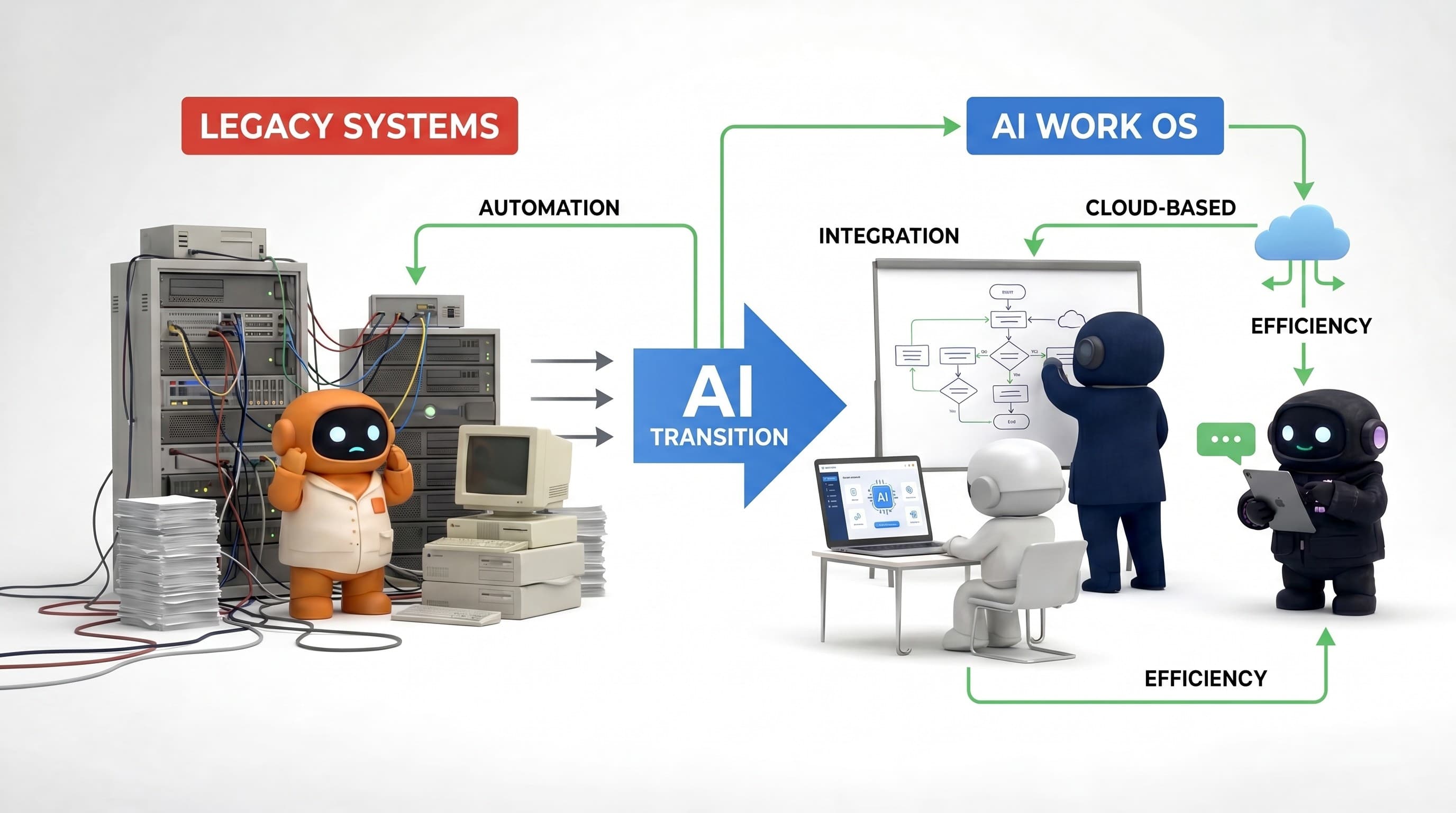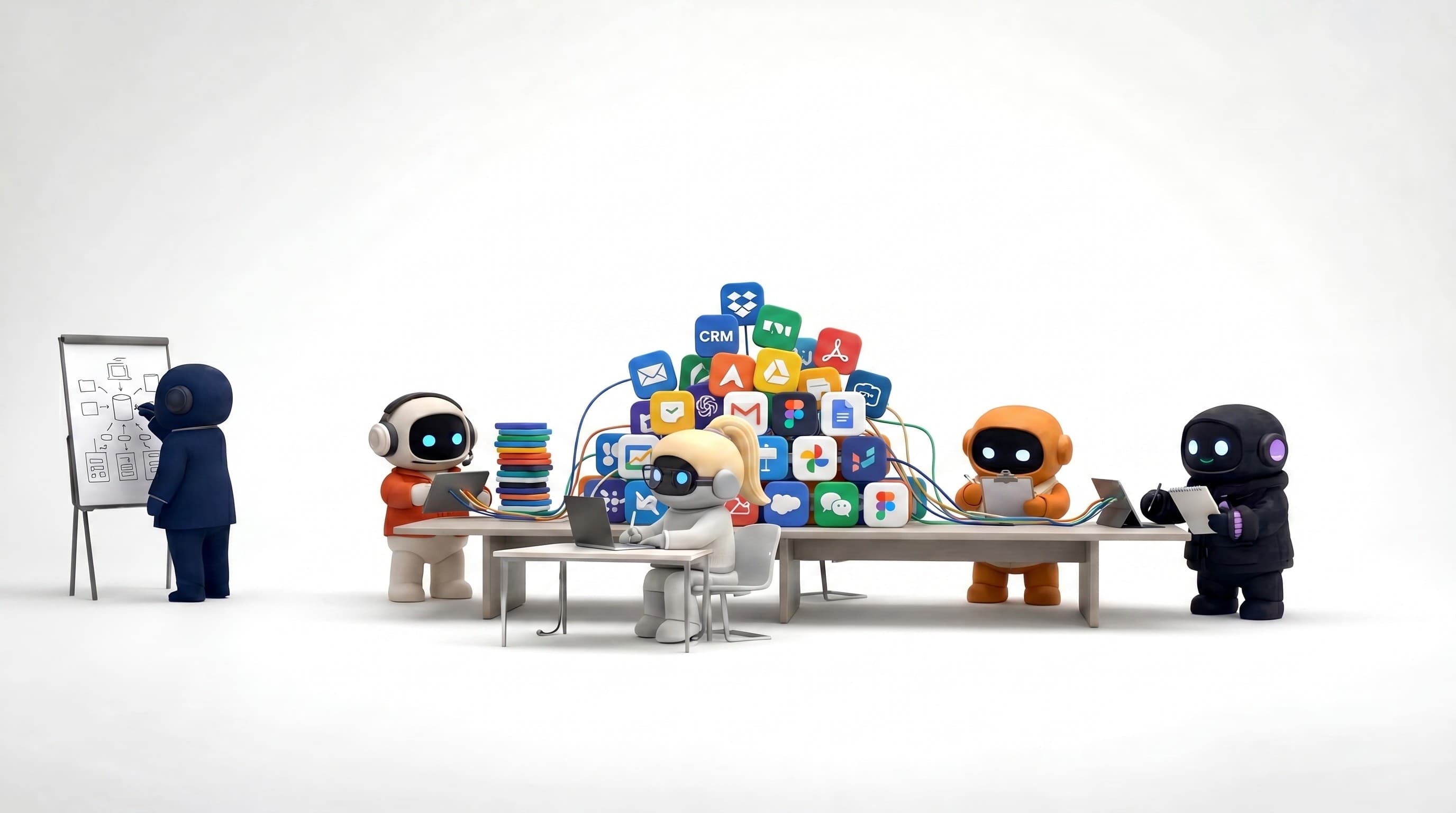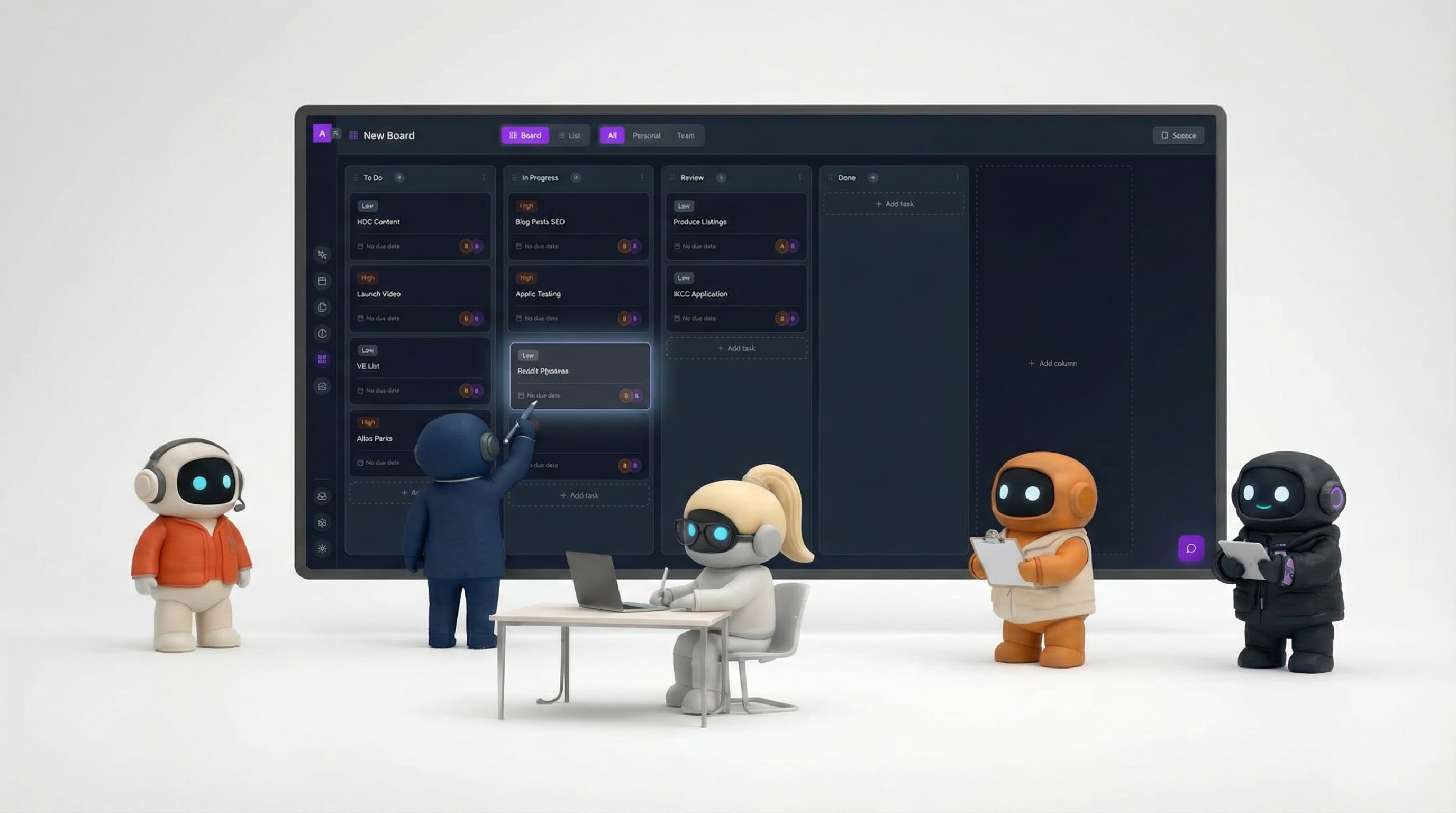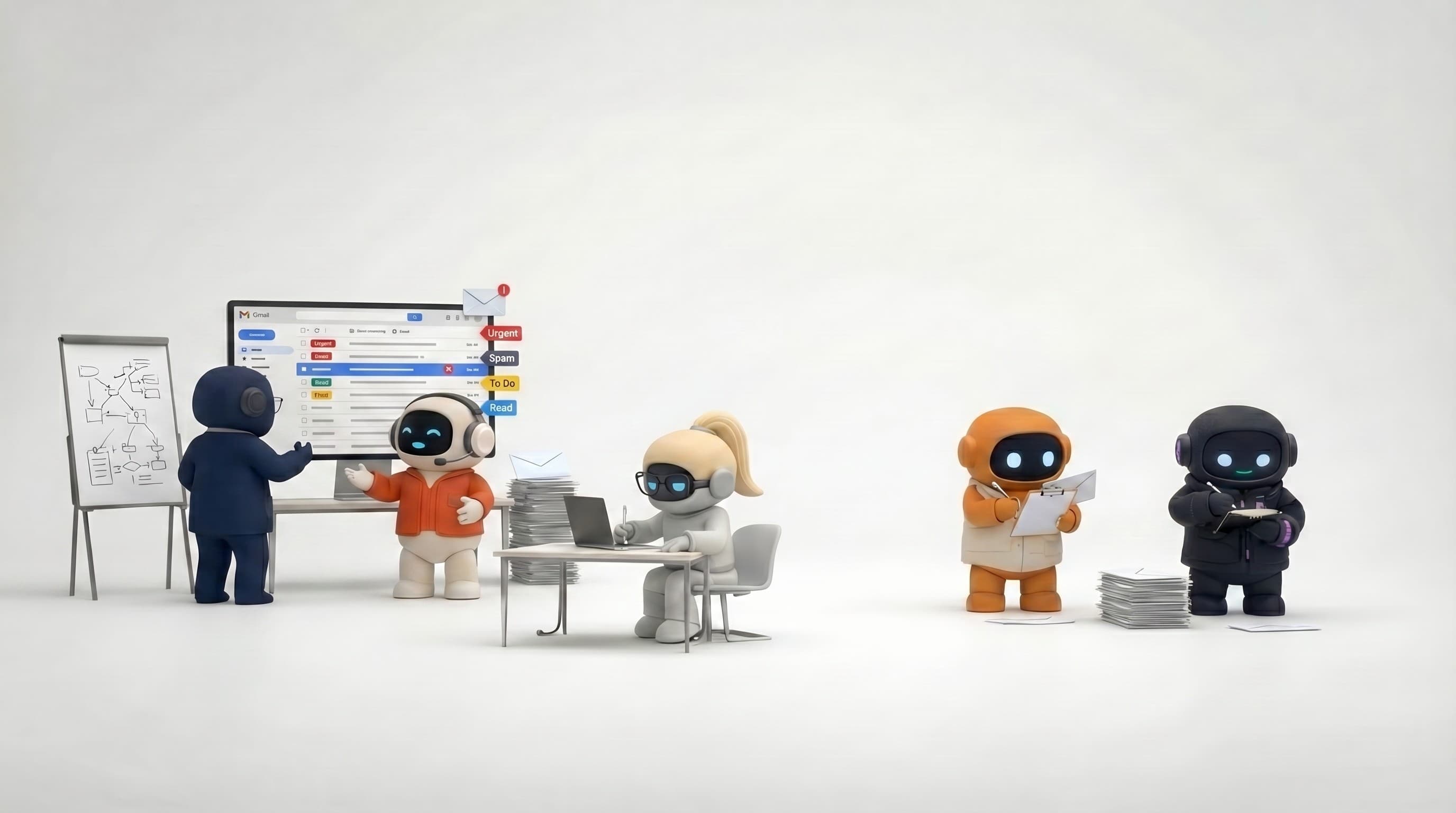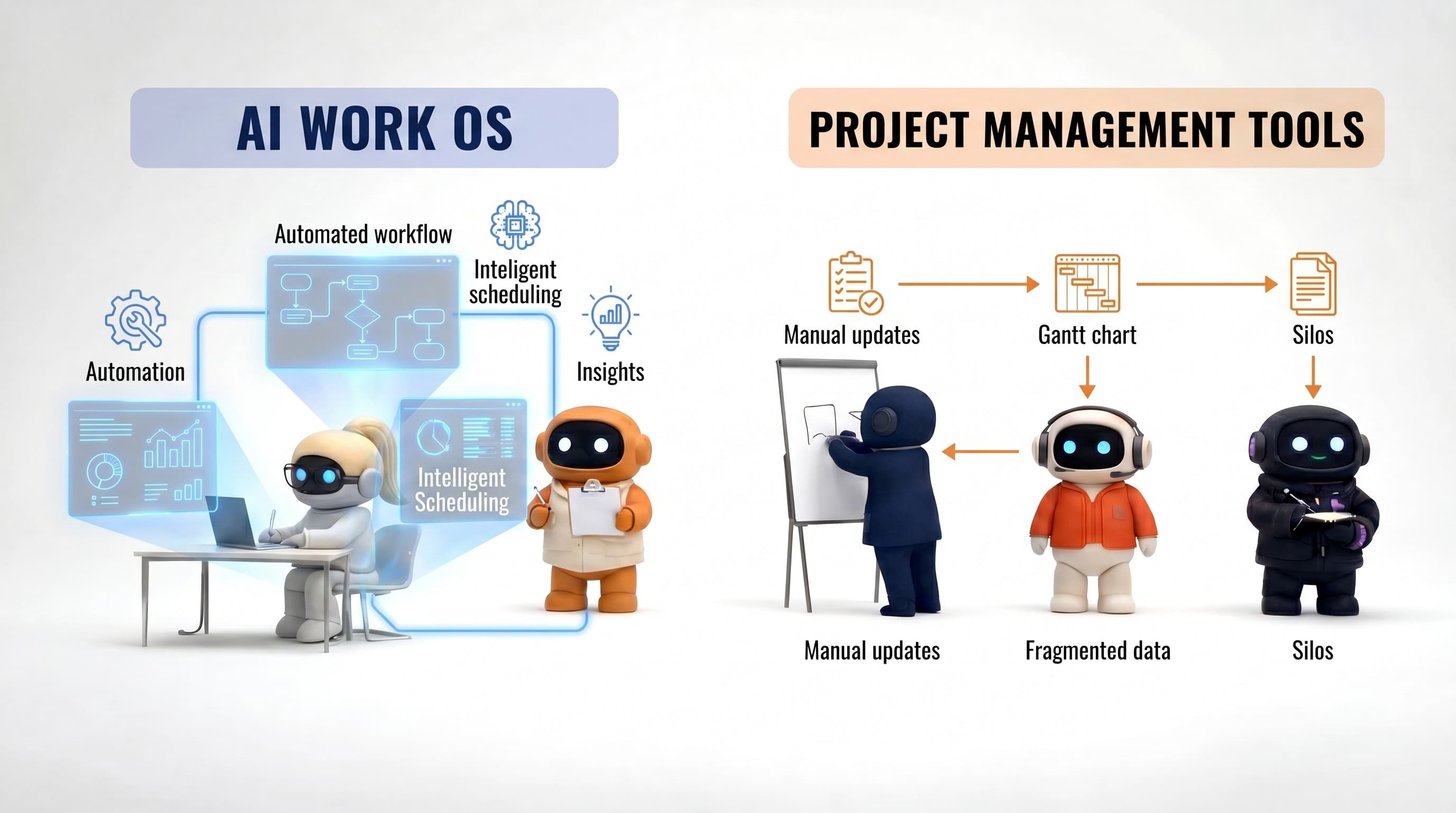

A project management tool tracks the work your team does. An AI Work OS does the work, using AI employees that act across your tools instead of just recording status. One is a system of record. The other is a system of action.
Key takeaway: Project management tools organize human work. An AI Work OS performs work. If your team is drowning in cards, statuses, and updates that someone still has to act on, you're managing work that an AI Work OS would just do.
The core difference in one sentence
Project management tools (Asana, Trello, ClickUp, Monday) are where you plan and track tasks. An AI Work OS is where tasks get executed by AI agents that can read your tools, take action, and report back.
A project tool answers "what's the status?" An AI Work OS answers "it's done."
What each one is built to do
Project management tools are systems of record. They give you boards, timelines, assignees, and statuses. They're excellent at making work visible. But they don't do the work. A task sitting in "In Progress" stays there until a human moves it. The tool tracks effort. It doesn't supply any.
An AI Work OS is a system of action. It pairs a workspace with AI employees that have access to your connected tools and a shared company brain. You don't just assign a task. An agent picks it up, does it across your real tools (email, CRM, docs), and brings back the result.
Side by side
| Project management tool | AI Work OS | |
|---|---|---|
| Primary job | Track and organize work | Execute work |
| Who does the task | A human | An AI employee |
| Acts across your tools | No, you switch tools | Yes, agents work across them |
| Knows your context | Only what's typed in | Reads a shared company brain |
| Output | A status update | A finished result |
| Best at | Visibility and planning | Getting things done |
They're not actually enemies
This isn't "throw away your project tool tomorrow." Many teams keep a project board for human-driven planning and roadmaps, and use an AI Work OS for execution. The board says what needs to happen. The AI Work OS makes a lot of it happen.
The shift is in where the work lands. Tasks that used to mean "a person does this, then updates the card" become "an agent does this, and the result shows up." The closer a task is to repeatable knowledge work (research, drafting, triage, follow-ups, reporting), the more an AI Work OS absorbs it. (See real examples in how to triage your inbox with AI and how to automate sales with AI, or the bigger picture in replace your tool stack with an AI Work OS.)
Who should consider an AI Work OS
If most of your "project management" is really tracking knowledge work that a capable person could do from a clear brief, an AI Work OS will remove a large chunk of it. That's especially true for founders and small teams who don't have the headcount to throw bodies at execution. (See why startups are replacing their tool stack with an AI Work OS, and the trade-off in AI employees vs. hiring.)
If your work is mostly physical, deeply bespoke, or requires human judgment at every step, a project tool plus people is still the right call.
How Agently fits
Agently is an AI Work OS. It combines a workspace, a team of AI employees, and a shared Brain so agents work with full context across your connected tools. It includes built-in project management, so you can plan and execute in one place, instead of tracking work in one app and doing it in ten others.