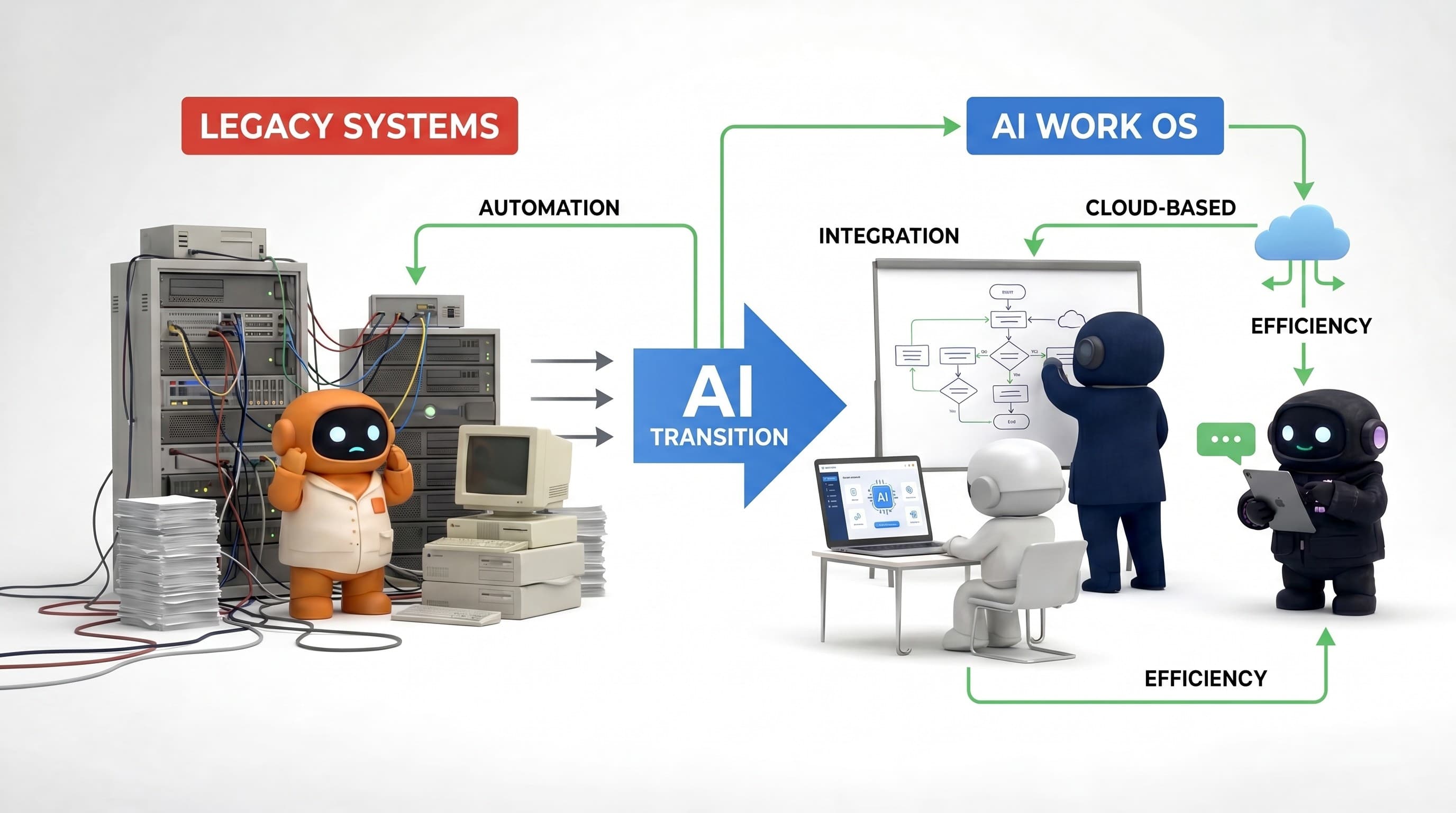

The best company brain for a startup is the one your whole team can buy without a sales call, that stays current on its own, and that every AI tool you use can read from, not a search box locked inside one more app. For a small team, fit is decided by four things: is it self-serve, does it stay current, is it open to your other AI tools, and does it act on what it knows or only answer.
Key takeaway: Startups don't lose to weak models, they lose to AI that has no memory of their business. A company brain fixes that by giving every agent one curated, current context to read from. The trick is picking one built for a five-person team, not a five-hundred-person one.
What a startup actually needs from a company brain
An enterprise buys a company brain to unify knowledge across a thousand people and a hundred tools. A startup has the opposite problem: a handful of people, a dozen tools, and no time to run a knowledge-management project. So the requirements are different.
Strip the category to what matters at your size and there are four:
- Buyable by a small team. Self-serve pricing, no seat minimums, no discovery call. If the first step is "book a demo," it's not built for you.
- Current without babysitting. The brain has to distinguish this quarter's pricing from last year's on its own. A store that goes stale the week you stop maintaining it is worse than no store.
- Open to the AI tools you already use. Your knowledge should be reachable from Claude, ChatGPT, or Cursor over MCP, not trapped inside one vendor's assistant.
- Able to act, not just answer. Answering questions is the floor. The leverage is an agent that uses the brain to draft the outreach, prep the call, and update the CRM, with your approval.
That first requirement quietly disqualifies most "enterprise brain" products. The fourth separates a company brain from plain enterprise search.
The real options for a startup
Here's how the category's best-known tools actually fit a 2–20 person team, honestly, including where each one's limits hide.
Agently, the company brain your AI tools share
Agently is built around the small-team premise from the start. It assembles a company brain, a temporal knowledge graph built continuously from your uploads and connected tools, and makes it available in two places at once. Inside Agently, Jarvis (one orchestrator that plans work and delegates to specialist sub-agents behind the scenes) uses the brain to actually do work across your connected tools. Outside Agently, the MCP server lets Claude, ChatGPT, and Cursor query the same brain, so your knowledge isn't locked inside our assistant.
Facts carry temporal validity, when your pricing changes, agents can tell current truth from superseded history, which a plain index can't. It's self-serve from $39/mo, no seat minimums, no demo.
The honest catch: Agently isn't trying to be a thousand-connector, permission-mirrored index for a large enterprise. Retrieval quality depends on what you connect and curate. It's for teams that want shared, current context powering both their AI tools and real work.
Notion AI, the brain where your wiki already lives
If your team already runs on Notion, its Business plan bundles AI search across your workspace and a modest set of connected apps. Fully self-serve, no minimums, the lowest-friction start if Notion is already home.
The catch: the brain is only as good as your Notion adoption, the connector catalog is a fraction of the alternatives, and Notion's MCP exposes Notion-native pages only, the cross-app knowledge its own AI reaches through connectors stays inside Notion's assistant.
Guru, the verified knowledge base
Guru pairs a knowledge base with a human verification loop, experts attest content is still true, and layers AI search over it. That loop is genuinely good for support and ops teams that need trustworthy answers.
The catch: Guru pulled public pricing in 2026, even the entry tier now routes through sales, and verification assumes someone maintains the cards, a real ongoing cost at five people. (Full head-to-head: Agently vs. Guru.)
Slite, the AI wiki middle ground
Slite pairs a clean team wiki with an AI assistant that answers from it and a doc-verification feature, at a lower price than the enterprise options. A practical fit for a small team that wants a real wiki plus AI answers.
The catch: it's fundamentally a wiki with AI on top, the knowledge is what your team writes down, and it doesn't act on that knowledge across your other tools. (Full head-to-head: Agently vs. Slite.)
Glean, powerful, but not for you yet
Glean is the best-known enterprise answer to "AI search across everything we know," and it's a strong product, at scale. But it doesn't publish pricing, sells only through demos, and buyer reports describe contracts starting around 100 seats. For a small team it isn't an expensive option; it isn't an available one.
(Prefer the open-source route? Onyx is free to self-host if you have an engineer who wants to own the ops, covered in our Glean alternatives breakdown.)
Side by side
| Buyable by a 5-person team? | Stays current on its own | Open to external AI tools (MCP) | Acts on knowledge? | |
|---|---|---|---|---|
| Agently | Yes, from $39/mo, self-serve | Yes, temporal graph, facts expire | Yes, all plans | Yes, via Jarvis + approval |
| Notion AI | Yes, $20/member/mo (annual) | Only what your team updates | Notion-native pages only | Within Notion |
| Guru | Barely, sales call, reported 10-seat min | Verified by humans (manual) | Yes (reportedly enterprise-gated) | Answers only |
| Slite | Yes, self-serve | Doc verification (manual) | Limited | Answers only |
| Glean | No, sales-only, ~100-seat reported floor | Yes, at enterprise scale | Yes, usage-billed | Yes, enterprise |
Pricing and packaging as of August 2026; sales-gated figures are buyer-reported.
How to choose
Already live in Notion and just need workspace answers? Notion Business is the shortest path, accept that the knowledge stays in Notion.
Support or ops team that needs verified, trustworthy answers above all? Guru's verification loop is the differentiator, go in ready for the sales conversation.
Want a clean team wiki with AI answers at a fair price? Slite is the practical middle ground.
Want one current company brain behind both your AI tools and real execution, buyable today? That's Agently, knowledge that doesn't just get found, but gets used.
Why this matters more in 2026
The shift this year is from AI assistants to AI employees: agents that plan and execute across your tools, not just answer. (More in AI agents vs. chatbots and AI employees vs. hiring.)
An assistant with no memory is annoying. An employee with no memory is dangerous, it'll confidently send the wrong email or quote last year's price. The more your agents can do, the more it matters that they all share one brain. Shared context is what turns a pile of disconnected agents into something that behaves like a team, and a single source of truth is what keeps that team from inventing facts. That's also why the AI Work OS category exists: the workspace is the body, the agents are the workers, and the company brain is the shared memory.