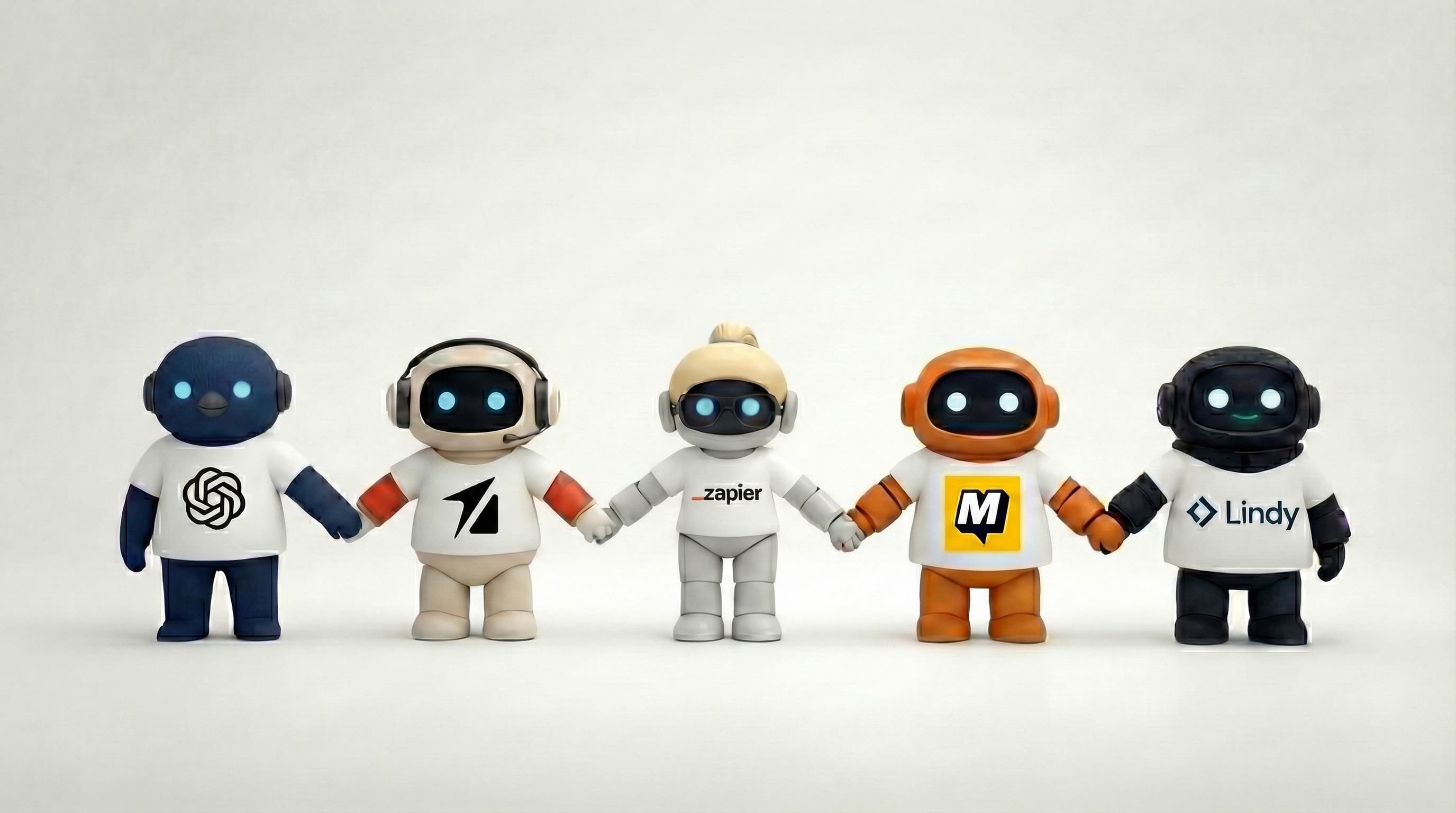

The right Zapier alternative depends on why Zapier is failing you. If your workflows break because the work needs judgment rather than more steps, you need an AI agent platform, not another automation tool. Make and n8n give you more power on the same rules-based model. Agent platforms change the model itself.
Key takeaway: Zapier is the right tool when a trigger is unambiguous and the action never varies. It is the wrong tool when the work needs a decision. Adding branches to a rules engine does not make it think.
Zapier earned its place in the stack: when a trigger is unambiguous and the action is identical every time, it is often the fastest path from idea to production. The failure mode is not “Zapier is bad.” The failure mode is using the wrong abstraction for work that is inherently fuzzy.
This article is for operators who typed “Zapier alternative” after one of these happened:
-
You built a twenty-step Zap and still manually fix half the runs.
-
You keep adding branches until the diagram looks like a circuit board, then nobody dares touch it.
-
You tried to bolt on OpenAI inside the flow and discovered you replaced a spreadsheet task with non-deterministic debugging.
We will walk through what breaks in practice, how that differs from a pricing problem, and how alternatives (n8n, general chat, embedded AI, workforce tools) map to real constraints, not a feature checklist.
Zapier alternative: at a glance
| If your main pain is… | Best first move | Typical tools |
|---|---|---|
| Task cost / volume at scale | Reprice or replace the automation layer | n8n, Make, native integrations |
| Branching / code / ops complexity | More expressive workflows or engineering | n8n, backend jobs, data pipeline |
| Messy text / judgment (email, tickets) | AI + review, not more Zap filters | AI agents vs. automation, workforce tools |
| Work scattered across apps | Shared workspace + knowledge base | AI Work OS, AI workforce |
Zapier vs. n8n vs. Make (automation-only comparison)
| Criteria | Zapier | n8n | Make (Integromat) |
|---|---|---|---|
| Sweet spot | Fast no-code integrations, huge app directory | Self-host, complex graphs, dev-friendly | Visual scenarios, different ops pricing |
| Hosting | Cloud | Cloud or self-hosted | Cloud |
| Learning curve | Low | Medium–high | Medium |
| Best when | You want speed and support | You want control, privacy, or heavy transforms | Zapier’s task math hurts your scenario shape |
| Not ideal when | You need deep custom code everywhere | You have zero ops capacity for self-host | You need semantic understanding of inbox text |
Deep dive: Zapier vs. n8n. If automation is the wrong layer entirely, use the “at a glance” table at the top of this guide, not every “Zapier problem” is a “Zapier competitor” problem.
What “Zapier alternative” usually means (four different problems)
Most teams use one search term for four different pains. Treating them as the same leads to buying the wrong product twice.
1. Cost and predictability (automation is right; vendor or unit economics are wrong)
Signal: Tasks or operations scale linearly with revenue, but Zapier bills per task. A form that fans out into seven updates burns seven tasks. A “dedupe” Zap that runs hourly burns tasks even when nothing changed.
What you actually need: A tool that charges in a shape that matches your workload, often self-hosted (n8n), Make with different bundling, or native integrations that avoid a middle layer.
What you do notneed: An AI agent to “think through” a CSV import that is already deterministic.
2. Complexity and control (you hit the ceiling of visual branching)
Signal: You need loops, error handling, retries with backoff, partial failure recovery, or transformations that are easier in code than in a GUI.
What you actually need: A more expressive automation layer, often n8n, scripts, or backend jobs. Sometimes a data engineer for a week beats six months of fragile Zaps.
What you do not need: Natural language for a problem that is really typed data and idempotent jobs.
3. Judgment under messy inputs (rules are the wrong tool)
Signal: The trigger is natural language: email bodies, Slack threads, support tickets, Gong summaries, PDFs. “If subject contains refund” worked until customers stopped writing the word refund.
What you actually need: A system that reads, classifies, and proposes actions, with human approval on consequential steps. That is the boundary between automation and agents.
What you do not need: Twelve new Zaps with regex that you will rewrite monthly.
4. Outcomes across tools (you do not want “pipes”; you want a workspace)
Signal: Work is not “move row A to sheet B.” It is “prepare for the call, draft the follow-up, open the task, attach the doc, notify the team”, with shared context so you are not pasting the same paragraph into four apps.
What you actually need: A work surface where agents, tasks, and knowledge live together, what we describe as an AI Work OS and AI workforce.
What you do not need: Another integration-only tool unless plumbing is still the bottleneck.
A concrete example: the “smart inbox” that is not smart
Imagine: New email in support@ → label → create ticket → notify Slack.
Zapier shines when:
-
The sender is always your form,
-
The payload is structured,
-
The mapping is one-to-one.
Zapier strains when:
-
Customers forward threads,
-
Attachments matter,
-
Tone signals urgency (“I will dispute the charge” vs “quick question”),
-
The right action is sometimes refund, sometimes education, sometimes escalate, and the rules overlap.
You can add filters. You can add paths. You can call an LLM step. At some point you are encoding policy in a DAG that nobody can audit.
That is not a failure of willpower. It is a category error : you are using rules where you need interpretation + policy + traceability.
Zapier vs. AI agents: side-by-side
| Dimension | Automation (Zapier-class) | AI agents (used well) |
|---|---|---|
| Input shape | Structured, repeatable | Unstructured, variable |
| Correctness | Binary (pass/fail per step) | Probabilistic (needs review) |
| Failure mode | Silent skips, duplicate rows | Plausible wrong actions if unchecked |
| Best oversight | Monitoring, alerts | Human-in-the-loop, sampling, playbooks |
| Economics | Per task / run | Tokens + time saved on human work |
| Audit / compliance | Deterministic logs | Needs policy + sampling + escalation paths |
| Time to first value | Often hours | Days–weeks (knowledge + review design) |
The practical rule we use internally: if two reasonable humans would disagree on the right action without a written policy, do not fully automate it with rules alone.
Chat vs. embedded AI vs. automation vs. workforce (which “alternative”?)
| Layer | Examples | Solves | Does not solve |
|---|---|---|---|
| Chat | ChatGPT vs. Claude | Drafting, analysis, ad-hoc reasoning | Persistent ops across tools |
| Embedded AI | Notion AI, ClickUp AI, Copilot | Work inside one product | Cross-app GTM workflows |
| Automation | Zapier, n8n, Make | If X then Y with clean data | Nuanced language + policy |
| Workforce / agents | AI employees, Agently | Judgment + tools + shared context | Magic without onboarding |
For a longer treatment, see AI agents vs. automation.
Alternatives, honestly bucketed
A) Still automation, cheaper, more flexible, or fewer hops
-
n8n, Strong when you want self-host, heavier transforms, or AI nodes without pretending the whole company is an agent. Compare Zapier vs. n8n.
-
Make, Useful when Zapier’s task math punishes your graph shape.
-
Native CRM / helpdesk automation, Underrated when your workflow is inside one system.
Choose this path when your pain is price, privacy, or expressiveness, not “we need opinions.”
B) Chat assistants, best for thinking, dangerous for operations at scale
ChatGPT, Claude (see ChatGPT vs. Claude) excel at drafting, rewriting, and reasoning over pasted context. They are weak as systems of record unless you build discipline: templates, review, and where outputs land.
Choose this path when work is episodic and human-paced. For why chat alone stalls growth-stage teams, read ChatGPT alternative for business.
C) Embedded AI, great inside one product, brittle across five
Notion AI, ClickUp AI, Microsoft Copilot, each is powerful when the team lives there. They stop helping when the real workflow crosses email, calendar, CRM, and social.
If that sounds familiar, compare Notion AI vs. ClickUp AI and our Notion AI alternative / ClickUp AI alternative angles, not to trash those products, but to match job shape to product shape.
D) AI employees / workforce platforms, when work is cross-tool and contextual
This is the bucket Agently plays in: role-shaped agents, shared Brain, Work and Pages, integrations (email, calendar, Notion, LinkedIn, X, etc.). The goal is not “another bot.” It is fewer handoffs between tools for repeatable commercial work.
When Zapier is still the correct answer
Keep automation (Zapier or n8n) when:
-
Schemas are stable (orders, subscribers, invoices).
-
Actions are idempotent (creating the same task twice is harmless or deduped).
-
Volume is high and margins are thin, AI adds cost without reducing human time.
-
Compliance requires deterministic logs, not model judgment.
Common good fits: ecommerce → accounting, form → CRM, webhook → data warehouse, calendar → Slack notification.
How to layer Agently without throwing away Zaps
Most mature stacks are hybrid :
-
Automation moves clean records and fires alerts.
-
Agents handle language, prioritization, and drafting where templates fail.
Examples:
-
Sales: Research + first-touch drafts + tasks in Work, see how to automate sales with AI.
-
Ops: Inbox triage and scheduling support, AI operations assistant.
-
Support: Policy-grounded replies with approval, AI customer support agent.
-
Marketing: Campaign scaffolding from shared context, AI marketing assistant.
A decision workflow you can actually run in a meeting
Answer in order:
-
Can we write the policy as a finite list of cases?
-
Yes → automation first.
-
No → proceed.
-
-
Is the cost driver tasks, or human minutes?
-
Tasks → reprice/replace Zapier (often n8n/Make/native).
-
Human minutes → agents + workflow redesign.
-
-
Does the work stay in one app?
-
Yes → embedded AI or native automation.
-
No → workspace / workforce layer.
-
-
What happens if the model is wrong?
- If “wrong” is unacceptable without review → require human gate, logging, and rollback paths, not more prompts.
Bottom line
“Zapier alternative” is a routing problem, not a brand problem. If you need cheaper or more powerful pipes, start with Zapier vs. n8n and friends. If you need judgment across messy inputs, compare categories, AI employees and an AI workforce, not another Zapier clone with an LLM step glued on.