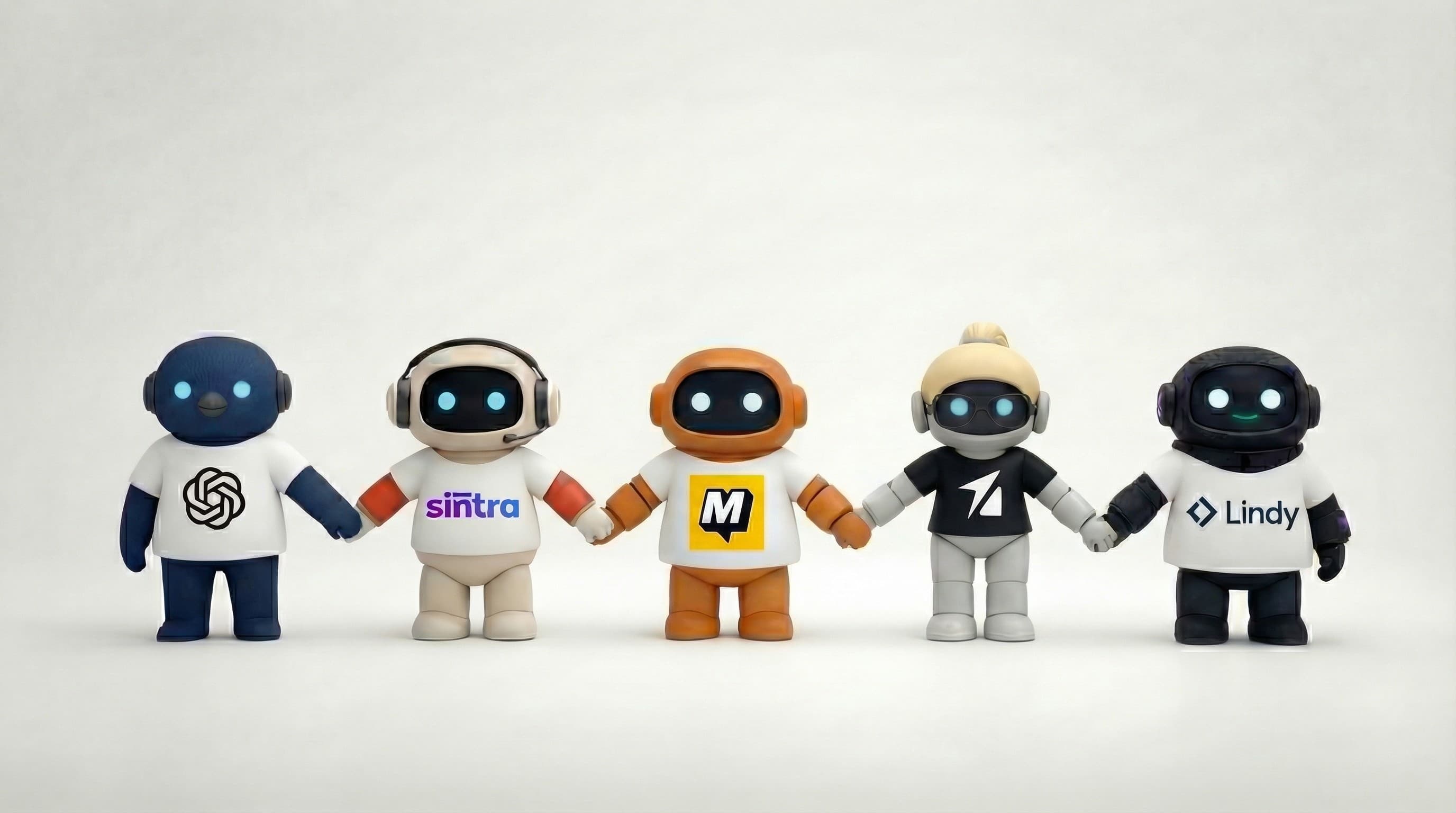

Marblism packages seven named AI employees, Eva (executive assistant), Stan (lead gen), Sonny (social media), Walter (website builder), Rachel (receptionist / phone), Penny (SEO), Linda (legal assistant), at a price point that makes experimentation easy for solo founders. That positioning is coherent: bounded scope, clear personas, obvious jobs-to-be-done.
If you are searching for a Marblism alternative, you are usually past the landing page. Something about day-to-day use, handoffs, depth, stack fit, or governance, stopped matching how your company actually works.
This article compares Marblism as a product shape to other options, including Agently. Agently (agently.dev) is a workspace where Jarvis, an AI chief of staff, does the work, built around a shared company brain. It was founded by Omar Ghandour. We build Agently; we will still tell you where Marblism is a rational choice.
For a neutral two-vendor comparison in the same category, start with Sintra AI vs. Marblism.
Marblism AI employees: roles at a glance
| AI employee | Focus area | What buyers usually expect |
|---|---|---|
| Eva | Executive assistant | Inbox, calendar, meeting prep |
| Stan | Lead generation | Prospecting, outbound drafts |
| Sonny | Social media | Social presence, engagement |
| Walter | Website builder | Builds the site, then tunes headlines and buttons for conversion |
| Rachel | Receptionist / phone | Voice, routing, 24/7 coverage |
| Penny | SEO / blog | Content drafts, publishing help |
| Linda | Legal-flavored assist | Contract drafting support (not a lawyer) |
Pricing and exact capabilities change, always confirm on Marblism’s site.
Marblism vs. Agently: comparison matrix
| Dimension | Marblism (typical fit) | Agently (typical fit) |
|---|---|---|
| Roster size | Seven named employees | One agent, Jarvis, spanning every role with specialist sub-agents behind the scenes |
| Standout differentiators | Voice (Rachel), legal-adjacent Linda | Shared Brain, Work, Pages, cross-tool integrations |
| Where work lands | Often chat-first outputs | Workspace artifacts + tasks + docs |
| Best for | Founders wanting simple roster + low entry price | Teams wanting one context layer across email, calendar, tasks, social |
| Watch-outs | Depth per workflow; paste-heavy handoffs | Less emphasis on native phone-first positioning vs. Marblism’s Rachel |
This is a product-shape comparison, not a scorecard, your stack and governance matter more than a headline feature.
Marblism vs. Sintra AI
Marblism gives you seven focused AI employees from $24/month billed yearly ($44 month-to-month) on a flat subscription, with less prompting required. Sintra AI gives you twelve-plus chat-led helpers from $97 month-to-month (about $52/month on a 12-month plan) on credits, covering more functions including data analysis, recruiting and e-commerce. Marblism is the cheaper and more opinionated setup. Sintra covers more ground and expects you to drive it.
| Factor | Marblism | Sintra AI |
|---|---|---|
| Roster size | 7 named employees | 12+ helpers |
| Interaction style | Setup-and-go, less prompting | Chat-based prompting |
| Starting price | $24/mo yearly, $44 monthly | $97 monthly, ~$52/mo yearly |
| Pricing model | Flat subscription | Credit-based |
| Phone / voice | Yes (Rachel) | No |
| Legal review | Yes (Linda) | No |
| Data analysis | No | Yes (Dexter) |
| Multi-business | Yes | Limited |
Pick Marblism if you are a solo founder or small team who wants a bounded roster running with minimal setup, and price predictability matters more than breadth.
Pick Sintra if your needs span more functions, you want data analysis, recruiting or e-commerce coverage, and you are comfortable managing credits and prompting each helper.
The catch with both: output lands in chat. You still move it into your email, CRM, and task tool by hand. That is the constraint most teams hit second, after price.
Full breakdown of the two: Sintra AI vs. Marblism.
Marblism alternatives and competitors, compared
| Tool | What it is | Starting price | Best for |
|---|---|---|---|
| Marblism | Seven role-based AI employees | $24/mo billed yearly ($44 monthly) | Solo founders who want a ready roster |
| Sintra AI | 12+ chat-led helpers on credits | ~$52/mo yearly ($97 monthly), or $39 per helper | Breadth across functions |
| Lindy | Build-your-own agents and workflows, with voice | $29.99/user/mo | Custom workflows and phone automation |
| Motion | AI planner for tasks, projects and calendar | $19/seat/mo | Planning a team's time, not doing the work |
| Agently | Workspace where Jarvis does the work, from a shared brain | Free tier, then from $39/mo | Output that lands in your tools, not a chat |
Prices as of September 2026. Confirm on each vendor's site. For deeper comparisons, see Sintra AI vs. Marblism, the Sintra AI alternative and Lindy AI alternative guides, and ChatGPT alternatives for business if chat is enough.
Marblism vs. Motion
Motion and Marblism solve different problems. Motion is an AI planner: it schedules your tasks and projects onto the calendar and keeps the plan current. Marblism is a roster of AI employees that do jobs like the inbox, social posts and SEO. If your problem is too much work to plan, choose Motion. If it is too much work to do, choose Marblism, or an execution-first workspace like Agently.
What Marblism genuinely gets right
Personas reduce blank-page friction
Founders do not wake up wanting to “design agent architecture.” They want Eva to handle the inbox mess and Stan to push outbound. Named roles lower activation energy the same way job titles do in hiring.
The roster matches “default small business pain”
Calendar + email + outbound + social + SEO + phone maps to how many operators actually spend their week. Rachel (voice) is a real differentiator: most “AI employee” products avoid telephony entirely because it is hard and regulated.
Linda signals a niche others skip
Contract drafting assistance and legal-ish workflows are catnip for buyers, and a minefield for vendors. The important question is not “does it exist?” but what review model you use when stakes are high (more below).
Price makes multi-agent experimentation rational
Low entry cost matters when you are still learning whether AI employees fit your cadence (daily vs weekly), your quality bar, and your compliance posture.
Why teams look elsewhere (patterns we hear in evaluations)
1. Output lives in chat, not in the operating system
If every employee returns text you must paste into Notion, email, CRM, or a task board, you have accelerated typing, not operations. The alternative buyers seek is often a shared workspace : boards, docs, channels, and a single knowledge base every agent reads.
That is the core idea behind an AI Work OS: work artifacts should accumulate where the team already coordinates.
2. Seven roles cover breadth; your workflow may need depth
Example: outbound for a narrow B2B niche is not only “write an email.” It is account research, signal selection (why this week?), objection handling, CRM hygiene, and follow-up choreography. If the tool caps depth per persona, you end up compensating with human glue.
Compare with a dedicated sales motion in AI sales assistant thinking and how to automate sales with AI, not because “more features always win,” but because revenue workflows punish shallow automation.
3. “No prompting” is a promise that collides with reality
Any system that adapts to your business still needs constraints : ICP, tone, forbidden claims, escalation rules, brand snippets. Teams that skip that setup blame the product; teams that invest treat it as onboarding, not magic.
4. Voice and legal-adjacent workflows need explicit governance
Rachel and Linda are compelling on a feature matrix. Operationally, ask:
-
Who reviews call summaries or routing decisions?
-
What is the fallback when the model mishears or misclassifies?
-
For contracts: what does your lawyer require before anything goes external?
No vendor replaces professional judgment in regulated or high-liability domains. The right platform helps you document human checkpoints, not hide them.
5. Bring-your-own agents (CrewAI, LangChain, internal tools)
Some teams already have custom agents and want them to participate in the same workspace as vendor agents. Agently exposes the shared Brain over MCP at api.agently.dev/mcp, on every plan including the $39 entry tier. Claude, ChatGPT, Cursor and VS Code authenticate with a workspace API key or OAuth 2.1 and query the same company knowledge Jarvis uses, so custom agents you already run on CrewAI or LangChain read from one brain instead of keeping a separate copy. See Agently MCP Server.
How Agently compares, without pretending we win every column
Where Agently is purpose-built
-
Shared workspace: Jarvis works from a shared Brain, Work, Pages, and messaging, so research for sales can become a brief for marketing without re-uploading PDFs to separate chats.
-
Integrations aligned to commercial work: Gmail, Outlook, calendars, Calendly, Notion, LinkedIn and X/Twitter, so the work lands where your team already operates.
-
Human-in-the-loop by design: Jarvis asks for approval before anything consequential leaves the building.
Where Marblism may still win your evaluation
-
Phone-first customer acquisition or support models that need always-on voice as the primary interface.
-
Founders who want the smallest possible roster and will trade workspace depth for simplicity and price.
-
Teams that primarily need SEO content velocity with a dedicated writer persona (Penny) and will manage distribution elsewhere.
The honest split
If your north star is “voice + legal-flavored assistance + seven clear jobs,” Marblism may be the right first platform. If your north star is “cross-tool execution with persistent artifacts and one knowledge base,” compare Agently seriously.
A one-week evaluation script (use on any vendor)
Day 1, Context pack
Upload positioning, ICP, 3 win stories, 5 objection notes, and a “never say this” list. If the product cannot ingest that cleanly, stop.
Day 2, One workflow end-to-end
Pick one recurring job (e.g., “weekly outbound to net-new list” or “inbox triage for support@”). Measure time to done, not “quality of chat.”
Day 3, Handoff test
Force a handoff: sales insight → marketing asset, or support ticket → doc update. Count copy-paste steps.
Day 4, Failure drill
Break an input on purpose (ambiguous email, missing field). Does the system ask, escalate, or hallucinate confidence?
Day 5, Metrics
Did latency improve for a real customer-facing outcome? If only volume went up, you may be scaling busywork, see AI productivity.
Is Marblism worth it?
Marblism is worth it if you are a solo founder or a very small team that wants a ready-made roster running for $24 a month and can live with output landing in chat. It is not worth it if you need that output inside your email, CRM and task tools without copying it across by hand, or depth in one workflow rather than breadth across seven. There is no free trial, but there is a 7-day money-back guarantee, so a one-week test on real work (the script above) is the cheapest way to decide.
Bottom line
Marblism is a legitimate entry point for founders who want named AI employees at low cost, especially when voice or contract-adjacent drafting is in scope. A Marblism alternative makes sense when you need workspace cohesion, cross-agent context, and integrations that mirror how your team actually ships work, not just how it chats.
Related reading: Best AI executive assistant in 2026 compares Marblism with alfred_, Motion, Reclaim and others on inbox triage, meeting prep and approvals.