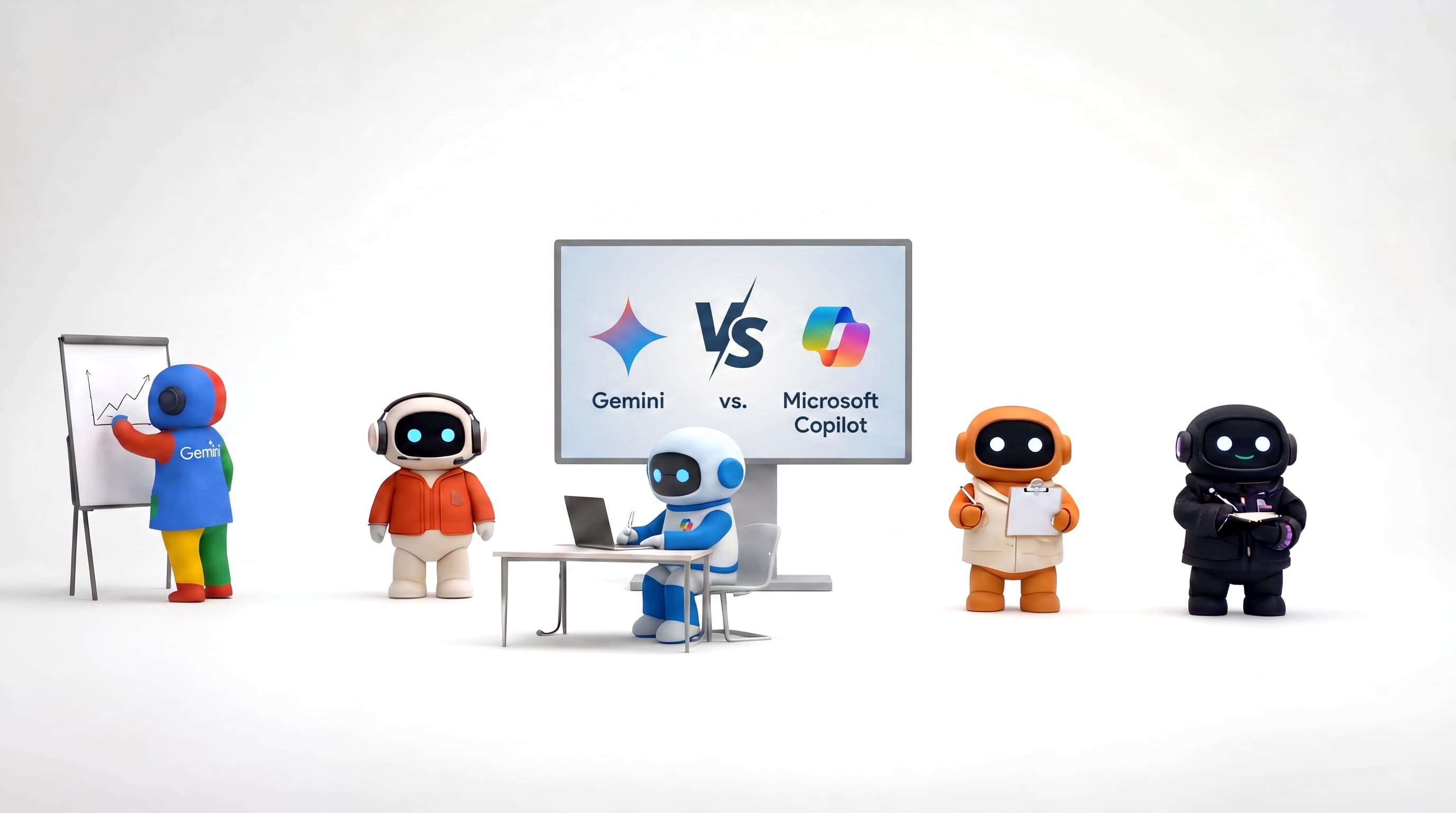

Gemini and Microsoft Copilot are the two big "AI inside your office suite" assistants, and the choice between them is decided almost entirely by which suite you already run. Gemini is native to Google Workspace; Copilot is native to Microsoft 365. Gemini has the edge on context length and multimodal work; Copilot has the edge on deep Office and Teams integration. On everything else they are closer than the marketing suggests.
Key takeaway: Choose Gemini if your team lives in Gmail, Docs, and Sheets. Choose Microsoft Copilot if your team lives in Word, Excel, Outlook, and Teams. Both help you write and analyze faster, but neither one runs a task end to end across your tools, which is the gap that matters most for real work.
Gemini and Microsoft Copilot both embed AI directly into the productivity tools your team uses every day, so the comparison is unusually simple at its core: which office ecosystem do you live in? But the details, multimodal ability, context windows, the new agent features both shipped in 2026, security, and pricing, still matter, and this guide covers them.
Read it alongside ChatGPT vs. Microsoft Copilot and Claude vs. Gemini if you are weighing the standalone assistants too.
Quick verdict
Choose Gemini if your team runs on Google Workspace, works with large or mixed-media documents, or already pays for Google. Choose Microsoft Copilot if your team runs on Microsoft 365 and wants AI inside Word, Excel, Outlook, and Teams. The deciding factor is almost always your existing office suite; both are strong, and neither shines as much outside its home ecosystem.
The fundamental difference
Gemini: native to Google Workspace
Gemini is woven into Gmail, Docs, Sheets, Slides, and Meet, was built multimodal from the ground up, and handles very large context windows (on the order of a million tokens). For Google users it shows up where the work already happens and can draw on Google's search and data ecosystem.
Philosophy: put AI inside Google Workspace, where Google users already work.
Microsoft Copilot: native to Microsoft 365
Copilot lives inside Word, Excel, PowerPoint, Outlook, and Teams, with a business chat grounded in your Microsoft data and permissions (Microsoft Graph). For Microsoft shops it is right there in the daily tools, and it reaches across email, calendar, chats, and files your organization already stores in the tenant.
Philosophy: put AI inside Microsoft 365, where Office users already work.
Feature comparison
Office integration
Each is deep and native within its own suite: Gemini across Google Workspace, Copilot across Microsoft 365. This is the single biggest factor, and it is decided entirely by which suite your team already uses. Copilot's advantage in Excel and Teams is particularly strong for finance and meeting-heavy teams; Gemini's advantage in Docs, Gmail, and Sheets is strongest for teams that write and collaborate in Google all day.
Winner: whichever suite you run on.
Notebooks: NotebookLM vs Copilot Notebooks
NotebookLM is Google's standalone research tool that grounds every answer in sources you upload yourself, and it works without a paid Gemini seat. Copilot Notebooks is a feature inside Microsoft 365 Copilot that groups content already in your tenant into one set to chat against. The split follows the wider pattern in this comparison: Google ships a separate product, Microsoft ships a surface inside the suite you already pay for.
| NotebookLM (Google) | Copilot Notebooks (Microsoft) | |
|---|---|---|
| Shape | Standalone app | Feature inside M365 Copilot |
| Sources | Files, links, and text you upload | Files and pages already in your tenant |
| Strongest at | Reading a pile of material you gathered | Pulling together work that already lives in M365 |
| Access | Usable without a Gemini seat | Requires a Copilot licence |
Pick NotebookLM if the material is external: research papers, PDFs, transcripts, competitor docs you collected yourself.
Pick Copilot Notebooks if the material is already inside Microsoft 365 and the value is in not exporting it.
What neither does: a notebook is a scoped reading set, not shared company memory. Close it and the context is gone. Nothing it worked out is available to the next person, the next task, or any other tool.
Winner: Split by where your material lives, not by which tool is better.
Multimodal and context length
Gemini has the edge here. Its very large context windows and native multimodal design let it ingest long or mixed-media documents, PDFs, images, and video, in one pass. Copilot handles Office documents well and reads across your tenant's files, but does not match Gemini's raw context ceiling for a single large input.
Winner: Gemini.
Agents and automation (new in 2026)
Both vendors spent 2026 pushing beyond chat into "agents." Microsoft added Copilot agents and Copilot Studio, which let you build task-specific helpers grounded in your Microsoft data. Google added agent tooling around Gemini (Gems and its agent platform) for Workspace. Both are real steps forward, but both remain scoped to their own suite, and both still hand the finished work back to a person to review and route. They automate within the office; they do not run a multi-step job across your whole stack on their own.
Winner: Tie, and, as covered below, this is exactly where a platform built to act across all your tools pulls ahead.
Gemini Enterprise vs. Microsoft 365 Copilot
Gemini Enterprise and Microsoft 365 Copilot are each vendor's company-wide AI platform. Gemini Enterprise (Google renamed Agentspace to Gemini Enterprise in October 2025) searches across your company's data, including Microsoft 365 and tools like Confluence, Jira and ServiceNow, and adds prebuilt agents and a no-code agent builder. Microsoft 365 Copilot works inside Office and Teams, grounded in Microsoft Graph, with Copilot Studio for building agents.
The practical difference is reach. Gemini Enterprise is the one that can straddle both suites, because it connects to Microsoft 365 data as well as Google's. Copilot goes deepest inside Microsoft 365 itself. Gemini Enterprise's Business edition is listed at $21 per seat per month with a 30-day free trial; Microsoft 365 Copilot Business is also $21 per user per month on an annual plan.
Winner: Gemini Enterprise if your data is spread across both suites; Microsoft 365 Copilot if it lives in Microsoft 365.
Data grounding and security
Copilot's business chat is grounded in your Microsoft data through Microsoft Graph and respects existing permissions, which enterprises value. Gemini is similarly grounded in your Google data and ties into Google's security and admin model. Both are enterprise-credible, both keep business data out of model training on paid tiers, and the real difference is which data estate they read.
Winner: Tie, split by ecosystem.
Admin and deployment
Both roll out through the suite's existing admin console, the Google Admin console for Gemini, the Microsoft 365 admin center for Copilot, so IT manages licenses, data controls, and access with tools they already know. If your organization is already standardized on one suite, the AI add-on inherits that governance rather than introducing a new one. This is a quiet but decisive advantage of both over standalone assistants.
Winner: Tie, split by ecosystem.
Pricing
Both are per-user add-ons. Microsoft 365 Copilot is an add-on to your existing Microsoft 365 licensing: $30/user/month for enterprise, while Microsoft 365 Copilot Business, for organizations up to 300 users, is $21/user/month on an annual plan (discounted to $18 through December 2026). Google now bundles Gemini's paid capabilities into Google Workspace Business and Enterprise plans rather than selling a separate add-on, so for most teams the cost is folded into the Workspace subscription. In both cases the value is highest when you already pay for the underlying suite. Confirm current numbers before a rollout, both vendors change pricing and packaging often.
Winner: Depends on your existing office subscription.
Side-by-side
| Factor | Gemini | Microsoft Copilot |
|---|---|---|
| Native suite | Google Workspace | Microsoft 365 |
| Strongest apps | Gmail, Docs, Sheets | Excel, Outlook, Teams |
| Multimodal / context | Very strong (around 1M tokens) | Strong within Office |
| Agents (2026) | Gems + agent platform | Copilot agents + Copilot Studio |
| Data grounding | Your Google data | Your Microsoft data (Graph) |
| Admin | Google Admin console | Microsoft 365 admin center |
| Pricing | Bundled into Workspace plans | ~$30/user/mo M365 add-on |
| Best for | Google Workspace teams | Microsoft 365 teams |
| Type | Assistant inside the suite | Assistant inside the suite |
Pricing at a glance
| Plan | Gemini (Google Workspace) | Microsoft Copilot |
|---|---|---|
| How it's sold | Bundled into Workspace Business/Enterprise | Add-on to Microsoft 365 |
| Typical business price | Included in Workspace subscription | ~$30/user/month |
| Free/trial | Consumer Gemini has a free tier | Limited free Copilot chat |
| Best value when | You already pay for Workspace | You already pay for Microsoft 365 |
Pricing and packaging change frequently for both, treat these as directional and confirm current details with the vendor before committing.
In practice: the same task, two suites
A manager asks for a summary of a long strategy doc, a slide outline, and a note to the team.
With Gemini on Google Workspace, it reads the Doc directly, drafts the outline for Slides, and writes the note in Gmail, without leaving Google.
With Copilot on Microsoft 365, it reads the Word doc, builds the outline in PowerPoint, and drafts the note in Outlook, without leaving Microsoft.
The experience is nearly mirror-image. Whichever suite holds your documents is the one where the AI feels effortless. And in both cases, the manager still has to read, approve, and send, the AI produced the drafts, not the outcome.
Best use cases
Reach for Gemini when you are:
-
A Google Workspace team living in Gmail and Docs
-
Handling very large or mixed-media documents
-
Already paying for Google Workspace
Reach for Microsoft Copilot when you are:
-
A Microsoft 365 team living in Office and Teams
-
Doing heavy work in Excel or running many Teams meetings
-
Rolling AI out inside an existing Microsoft tenant
What changed in 2026
The headline shift this year is that both assistants grew agent features, Copilot agents and Copilot Studio on the Microsoft side, Gems and agent tooling on the Google side. That narrows the old "it only drafts" critique somewhat. But the boundary is still the suite: a Copilot agent is strongest inside Microsoft 365, a Gemini agent inside Workspace, and both are built to assist a person rather than own an end-to-end process that spans your CRM, your support inbox, your project board, and your documents at once. Knowing where that boundary sits is the key to setting expectations before a rollout.
Limitations to keep in mind
Each assistant's advantage largely disappears outside its home suite, so a mixed-suite organization gets uneven value. Both can produce confident but wrong output and should be reviewed on anything important. The new agent features add real capability but also new configuration and governance overhead. And as with all of these tools, capabilities and pricing change frequently, so confirm current details before a rollout.
The reality: both are assistants in your office
Whichever suite you use, Gemini and Copilot are assistants inside your documents. You ask, they draft or summarize, and then you do the work. Even with the 2026 agent features, they help you write and analyze, they do not reliably run a task end to end across every business tool on their own. For a lot of real work, the bottleneck is not a better draft; it is that a human still has to act on it, in the right tool, at the right time.
That is a different category. In Agently, Jarvis, an AI chief of staff, acts across your tools for sales, operations, marketing, support and research. It works from one company brain in one shared workspace, so instead of drafting inside a document, it does the task and brings back the result for you to approve. Gemini and Copilot help you write. Jarvis does the work, whether your documents live in Google or Microsoft.
Bottom line
Choose Gemini if you live in Google Workspace and want native, multimodal AI with a very large context window.
Choose Microsoft Copilot if you live in Microsoft 365 and want native AI in Office, Excel, and Teams.
Look beyond both if your bottleneck is not the draft but the doing, and you want AI that acts across your tools from one shared brain, no matter which office suite you run.
Agently is a workspace where Jarvis, an AI chief of staff, does the work across your tools from one shared brain, whichever office suite you run. Try it free.