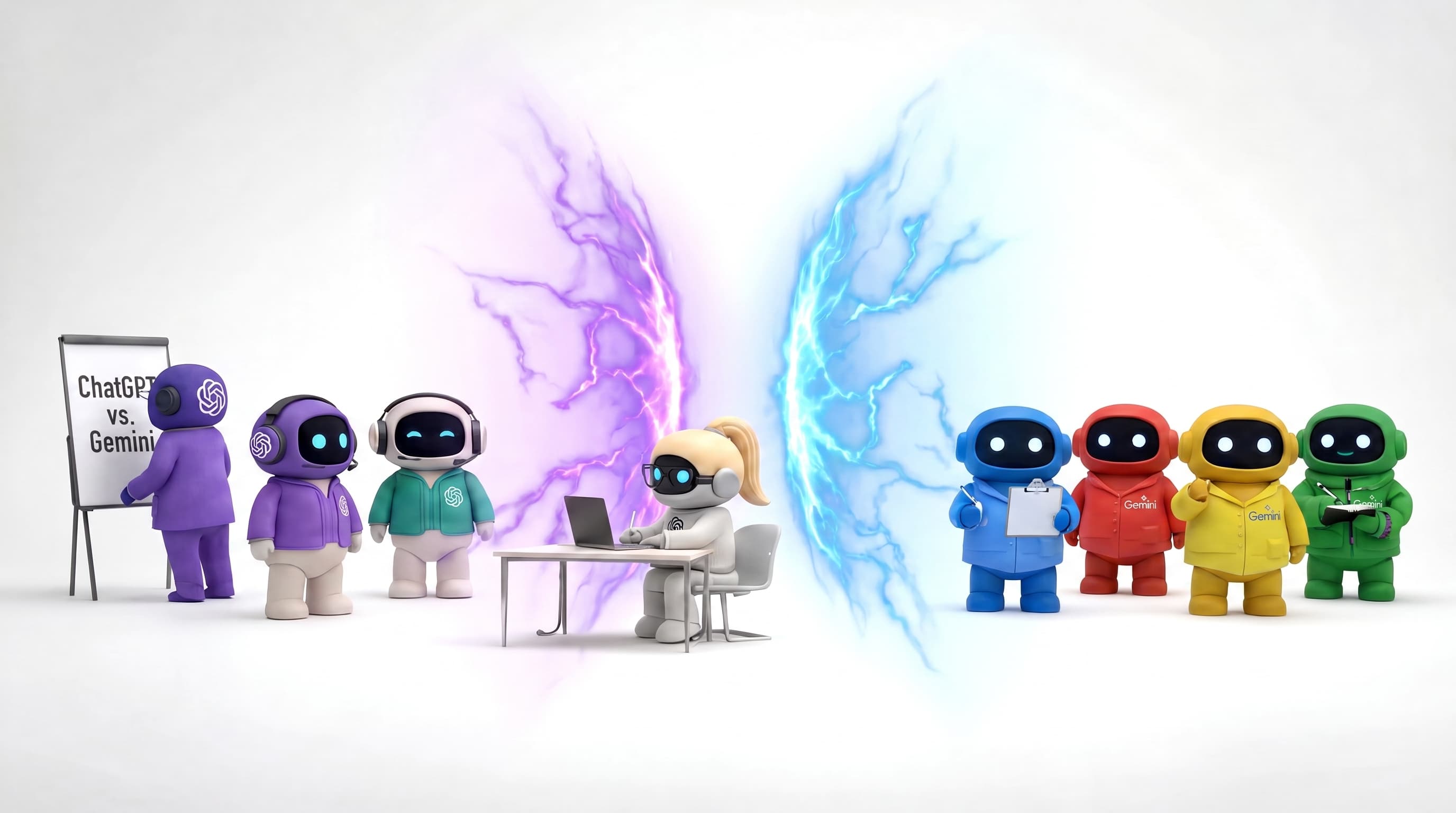

ChatGPT and Gemini are both excellent, so the choice is rarely about raw intelligence, it is about your ecosystem and the work you do most. ChatGPT is the broad, ecosystem-rich all-rounder with class-leading coding; Gemini is the multimodal, long-context assistant that lives inside Google Workspace.
Key takeaway: Pick ChatGPT for the widest ecosystem, top-tier coding, and custom GPTs. Pick Gemini if you live in Google Workspace, work with very large or mixed-media documents, or want AI bundled with a Google plan you already pay for. Many teams keep both and route by task.
ChatGPT and Gemini are the two most widely used AI assistants in the world, and both are genuinely excellent. So the choice is rarely about which is "smarter" in the abstract. It is about ecosystem, integrations, and the specific work you do most. ChatGPT, from OpenAI, is the broad, ecosystem-rich all-rounder. Gemini, from Google, is the multimodal, long-context assistant that lives inside Google Workspace.
This guide compares them across the dimensions that actually change your day: ecosystem, reasoning, coding, multimodal ability, context length, and pricing. If Claude is also on your list, read it alongside ChatGPT vs. Claude and Claude vs. Gemini.
Quick verdict
Choose ChatGPT if you want the widest ecosystem, top-tier coding, and a flexible assistant you can extend with custom GPTs and integrations. Choose Gemini if you live in Google Workspace, work with very large or mixed-media documents, or want AI bundled with a Google plan you already pay for. Both are strong general assistants; your existing stack usually decides it.
The fundamental difference
ChatGPT: the broad ecosystem leader
ChatGPT has the largest assistant ecosystem around it: custom GPTs, a big library of integrations, voice and image tools, and a huge community producing prompts, workflows, and tutorials. It is strong at general reasoning, writing, and especially coding, and it goes wherever you take it rather than being tied to one office suite.
Philosophy: a flexible, general assistant made more powerful by a large ecosystem.
Gemini: native to Google, built multimodal
Gemini is strongest when you already live in Google's world. It is woven into Gmail, Docs, Sheets, and Slides, was built multimodal from the ground up, and offers some of the largest context windows available. Its edge is being where Google users already work and handling big, mixed-media inputs in one pass.
Philosophy: a multimodal assistant embedded where Google users already work.
Feature comparison
Ecosystem and integrations
ChatGPT's ecosystem is its moat. Custom GPTs let you package task-specific assistants, and a wide integration library plus a large developer community mean there is usually a ready-made way to connect it to your workflow. Gemini's integration story is different but equally real inside Google: it reaches natively into Gmail, Docs, and Drive, which is unmatched if that is your stack. Outside Google, ChatGPT has broader third-party reach.
Winner: ChatGPT for breadth, Gemini if you live in Google Workspace.
Reasoning and writing
Both are excellent reasoners. ChatGPT is consistently strong across a very wide range of tasks and tends to be a dependable default. Gemini is a strong reasoner that pulls ahead when a task spans multiple formats at once, such as reasoning over a long report that mixes text, tables, and images.
Winner: Close. ChatGPT for consistent all-round reasoning, Gemini for multimodal.
Coding
ChatGPT is among the best coding assistants available, with strong generation, debugging, and explanation, plus tooling and integrations that developers rely on daily. Gemini is a capable coder and is especially convenient inside Google Cloud and Google's developer tools.
Winner: ChatGPT for general coding, Gemini within Google Cloud.
Multimodal and context length
This is Gemini's clearest advantage. It handles very large context windows, on the order of a million tokens, and was designed multimodal, so it ingests long documents, large codebases, or hours of transcript in a single pass. ChatGPT handles text, images, voice, and files well, but its context ceiling is generally lower.
Winner: Gemini.
Pricing and access
Both offer a capable free tier and a paid personal plan in the ballpark of twenty dollars per month, plus usage-based API pricing for builders. The difference is bundling: Gemini's paid tier is often packaged with Google One or Workspace, so Google customers may effectively get it at a discount, while ChatGPT is priced as a standalone product. (Check current plans on each vendor's site, since tiers change often.)
Winner: Even, edge to Gemini if you already pay Google.
Side-by-side
| Factor | ChatGPT | Gemini |
|---|---|---|
| Ecosystem | Largest, custom GPTs | Native Google Workspace |
| Reasoning | Excellent, consistent | Excellent, strongest multimodal |
| Coding | Class-leading | Strong, great on Google Cloud |
| Multimodal / context | Strong | Very strong (around 1M tokens) |
| Pricing | Standalone, ~$20/mo tier | ~$20/mo, often bundled with Google |
| Best for | Broad use, builders, coding | Google users, big docs, multimodal |
| Type | Chatbot / assistant | Chatbot / assistant |
Pricing at a glance
| Plan | ChatGPT | Gemini |
|---|---|---|
| Free tier | Yes (limited models) | Yes (limited) |
| Personal paid | ~$20/month | ~$20/month, often bundled with Google One |
| Business / Team | Per-user plans | Bundled into Google Workspace plans |
| API | Usage-based | Usage-based |
| Best value when | You want a standalone all-rounder | You already pay for Google |
Both vendors change tiers and limits often, confirm current pricing before standardizing a team.
In practice: the same task, two tools
You drop in a 90-minute meeting recording plus a long spec and ask for notes, action items, and a follow-up email.
With Gemini, the long context and native multimodal handling let it take the whole transcript and document at once, and if they live in Google Drive it can pull them directly and write the follow-up into a Doc.
With ChatGPT, you may lean on its ecosystem, a purpose-built custom GPT or an integration, and its output, especially the follow-up email and any code or structured formatting, tends to be polished and ready to use.
The pattern: Gemini shines at ingesting and integrating within Google, ChatGPT shines at range, coding, and a deep ecosystem.
Best use cases
Reach for ChatGPT when you are:
-
Coding, debugging, or building on an API
-
Extending AI with custom GPTs or many integrations
-
Doing varied, general work and want a dependable all-rounder
Reach for Gemini when you are:
-
Working all day in Gmail, Docs, and Sheets
-
Summarizing very large or mixed-media documents
-
Already paying for Google One or Workspace
Limitations to keep in mind
Both can be confidently wrong, so review high-stakes output. ChatGPT's raw context ceiling is lower than Gemini's, and Gemini's strongest advantages fade if you are not a Google shop. Versions, limits, and pricing move quickly on both sides, so verify current specifics before standardizing a team on either.
What changed in 2026
Both assistants moved well beyond answering this year. OpenAI expanded ChatGPT's agentic features and tool use, while Google pushed Gemini deeper into Workspace and its own agent tooling. The gap in raw capability keeps narrowing, which is why the decision increasingly comes down to ecosystem fit, and, for real execution across your whole stack, to whether a chat assistant is even the right category at all (more on that below).
The reality: both are chatbots
Here is what neither ChatGPT nor Gemini changes: they are chatbots. You ask, they answer, and then you do the work. They draft the email but do not send it, surface the action items but do not create the tasks, analyze the data but do not update your CRM. For a lot of real work, the bottleneck is not a better answer, it is that a human still has to carry that answer across their tools.
That is a different category: an AI employee platform. Agently provides AI employees for sales, operations, marketing, support, and research that use top models like these to act across your tools. They share a company brain and work in one workspace, so instead of handing you a draft, they do the task and bring back the result. ChatGPT and Gemini answer. Agently's AI employees act.
Bottom line
Choose ChatGPT for the largest ecosystem, top-tier coding, and a flexible all-rounder.
Choose Gemini for the largest context windows, native multimodal ability, and deep Google Workspace integration.
Look beyond both if your bottleneck is not the answer but the doing, and you want AI employees that act with a shared brain in one workspace.
Agently provides AI employees that work alongside your team in a shared workspace, handling sales, marketing, operations, support, and research. Try it free.