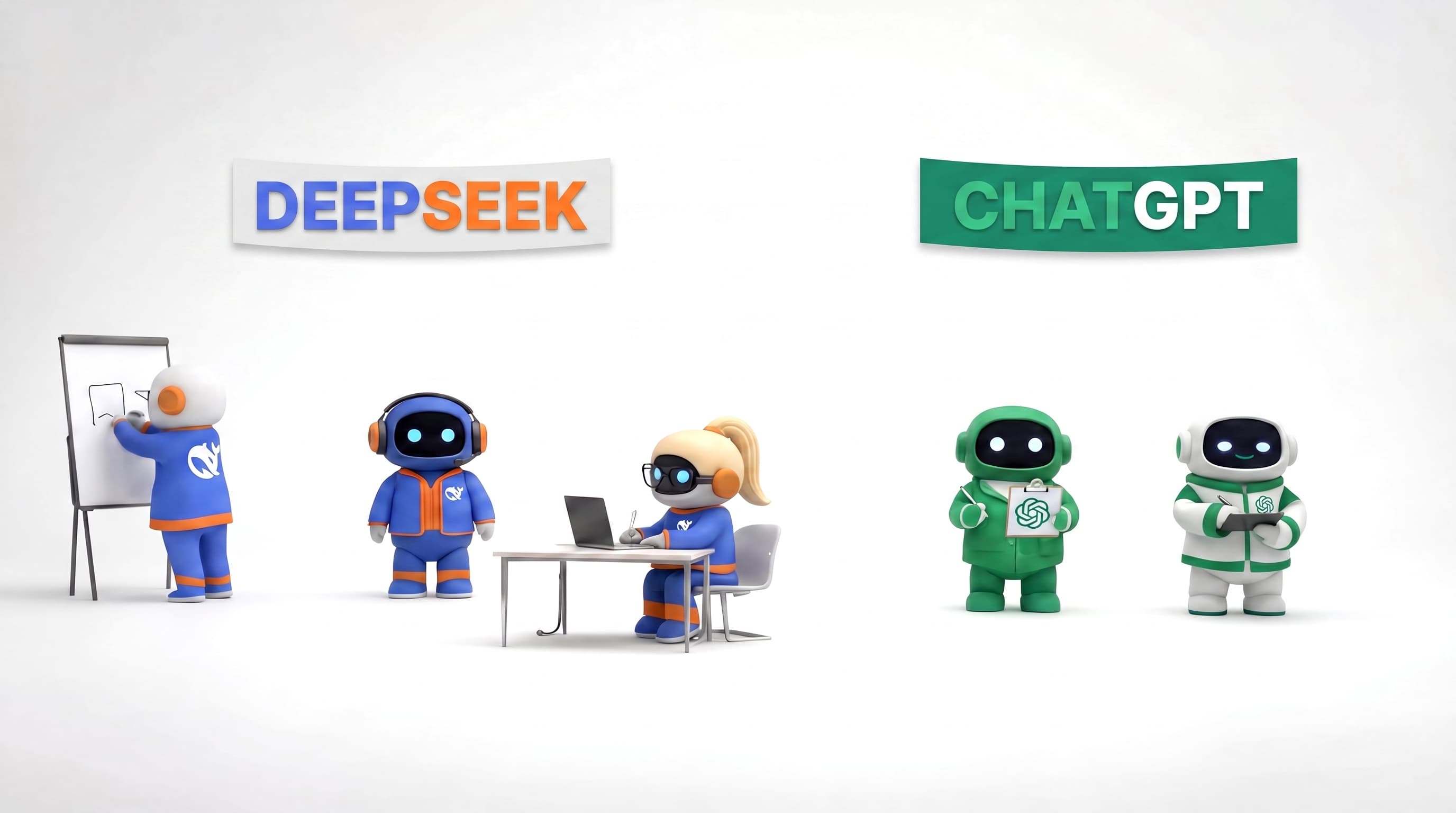

DeepSeek and ChatGPT both give you a capable AI assistant, but they come from opposite ends of the market. DeepSeek made its name with strong, efficient, open-weight models that cost a fraction of the incumbents. ChatGPT is the polished, feature-rich all-rounder with the largest ecosystem. The choice usually comes down to whether you optimize for cost and control or for polish and ecosystem. This guide covers both.
For the other open-versus-closed matchups, read this alongside Llama vs. ChatGPT and DeepSeek vs. Claude.
Quick verdict
Choose DeepSeek if cost, openness, or self-hosting matter, and your work leans technical, especially math and code. Choose ChatGPT if you want a polished assistant with voice, images, custom GPTs, and the largest ecosystem, and you value consistent all-round quality. DeepSeek competes hard on price and reasoning; ChatGPT wins on polish and breadth.
The fundamental difference
DeepSeek: efficient, open, and low-cost
DeepSeek is known for strong reasoning models that are remarkably efficient and inexpensive, with open weights you can self-host or reach through a very cheap API. That makes it attractive for cost-sensitive and technical teams. The trade-off is a smaller ecosystem and fewer consumer-polish features than ChatGPT.
Philosophy: deliver frontier-level reasoning cheaply and openly.
ChatGPT: polished and all-round
ChatGPT is a refined assistant for writing, coding, and reasoning, with custom GPTs, voice, image generation, and broad integrations. The trade-off is higher cost at scale and closed models accessed through OpenAI.
Philosophy: a polished, general assistant backed by a large ecosystem.
Feature comparison
Reasoning quality
DeepSeek is a strong reasoner, particularly on math and code, and is competitive with top models on many tasks. ChatGPT is excellent and highly consistent across the widest range of tasks. On pure reasoning they are close; ChatGPT is more consistent across everything.
Winner: Close, edge to ChatGPT for breadth and consistency.
Cost
This is DeepSeek's headline advantage. Open weights plus very low API pricing make it cheap to run at scale, while ChatGPT's strongest models cost more, especially at volume.
Winner: DeepSeek.
Openness and control
DeepSeek's open weights allow self-hosting, fine-tuning, and keeping data in-house. ChatGPT is closed and hosted by OpenAI.
Winner: DeepSeek.
Ecosystem and features
ChatGPT offers custom GPTs, voice, images, and the largest integration ecosystem, a polished experience out of the box. DeepSeek is focused on the models, with fewer consumer features and integrations.
Winner: ChatGPT.
Side-by-side
| Factor | DeepSeek | ChatGPT |
|---|---|---|
| Reasoning | Strong (math, code) | Excellent, broad |
| Cost | Very low, open weights | Higher at scale |
| Openness | Open, self-hostable | Closed |
| Features | Focused on the model | Voice, images, custom GPTs |
| Ecosystem | Small | Largest |
| Best for | Cost-sensitive, technical, self-hosting | Polished, all-round use |
| Type | Chatbot / model | Chatbot / assistant |
In practice: two different priorities
You need to process a high volume of documents with AI every day.
With DeepSeek, the low per-token cost (or self-hosting) makes running that volume dramatically cheaper, and strong reasoning handles the technical work well.
With ChatGPT, you get a more polished experience and ecosystem, but the same volume costs more, and you are on closed, hosted models.
The pattern: DeepSeek wins on cost and control at volume, ChatGPT wins on polish, features, and consistent quality.
Best use cases
Reach for DeepSeek when you are:
-
Running AI at high volume and want to minimize cost
-
Self-hosting or fine-tuning for data control
-
Doing technical, math- or code-heavy work
Reach for ChatGPT when you are:
-
A team or individual who wants a polished, ready assistant
-
Using voice, images, or custom GPTs
-
Doing varied work and want dependable all-round quality
Limitations to keep in mind
DeepSeek's ecosystem and consumer features are thinner, and self-hosting requires engineering. ChatGPT costs more at scale and is closed. Both can be confidently wrong, and open models raise their own data-governance questions depending on how you deploy them. Model versions and pricing change quickly.
The reality: both are chatbots
Whichever model you prefer, DeepSeek and ChatGPT are chatbots. You ask, they answer, and then you do the work. They generate text, but they do not send the email, update the CRM, or run the task across your tools. For a lot of real work, the bottleneck is not a better or cheaper answer, it is that a human still has to act on it.
That is a different category: an AI employee platform. Agently provides AI employees for sales, operations, marketing, support, and research that use strong models to act across your tools. They share a company brain and work in one workspace, so instead of handing you a draft, they do the task and bring back the result. DeepSeek and ChatGPT answer. Agently's AI employees act.
Bottom line
Choose DeepSeek for low cost, openness, and strong technical reasoning.
Choose ChatGPT for polish, features, and the largest ecosystem.
Look beyond both if your bottleneck is not the answer but the doing, and you want AI employees that act with a shared brain in one workspace.
Agently provides AI employees that work alongside your team in a shared workspace, handling sales, marketing, operations, support, and research. Try it free.