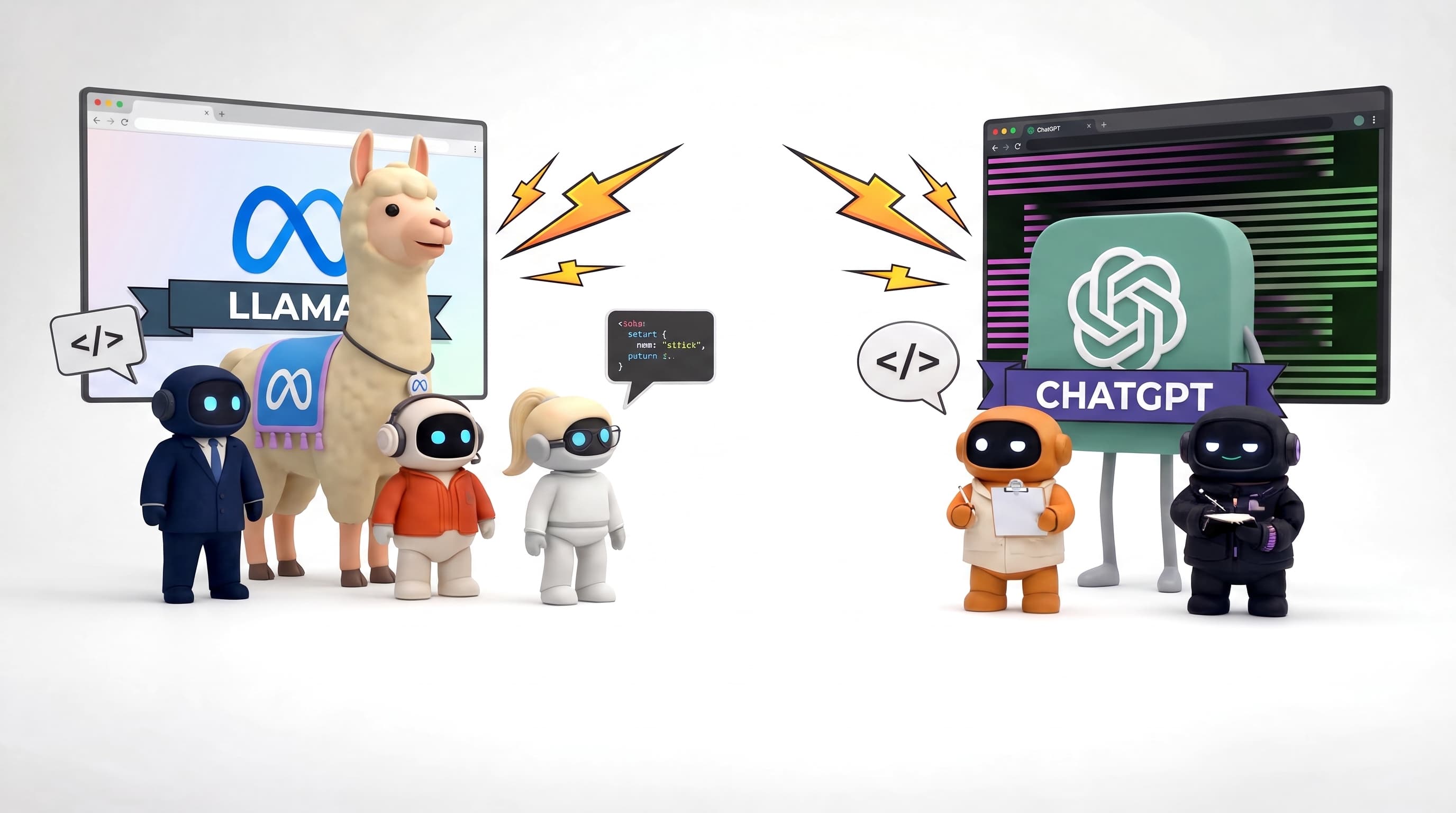

Llama and ChatGPT represent two philosophies of AI. Llama, from Meta, is a family of open-weight models you can download, self-host, fine-tune, and own. ChatGPT, from OpenAI, is a polished, hosted assistant with the largest ecosystem around it. One is a foundation you build on; the other is a finished product you use. This guide compares them across control, out-of-the-box experience, cost, and best fit.
For the closed-model matchups, read this alongside ChatGPT vs. Claude and DeepSeek vs. ChatGPT.
Quick verdict
Choose Llama if you want open weights you can self-host, fine-tune, and keep in-house, and you have the technical capability to build the product layer. Choose ChatGPT if you want a polished, ready-to-use assistant with no infrastructure and a huge ecosystem. Llama is for builders and privacy-sensitive teams; ChatGPT is for anyone who wants it to just work.
Key differences between Llama and ChatGPT
The key difference is ownership. Llama is a family of open-weight models from Meta that you download, run and fine-tune yourself. ChatGPT is OpenAI's hosted assistant, which you use as a finished product. Almost every other difference follows from that:
| Llama | ChatGPT | |
|---|---|---|
| What you get | Model weights | A complete app and API |
| Where it runs | Your servers or any cloud | OpenAI's cloud |
| Customization | Fine-tune the model itself | Instructions, custom GPTs, connectors |
| Data | Never leaves your infrastructure | Governed by OpenAI's policies (business plans exclude training) |
| Cost | Compute plus engineering time | Per-seat subscription or per-token API |
| Out of the box | Nothing: you build the interface, tools and safety | Search, voice, files, agents, ready to use |
| Best for | Builders and privacy-sensitive teams | Everyone who wants it to just work |
Which Llama? Llama 4 Scout and Maverick, released in April 2025, are Meta's current open-weight models. Meta's Muse Spark, launched in April 2026 by its new superintelligence lab, is a separate model line, so if open weights matter to you, check which Meta model you are actually getting.
The fundamental difference
Llama: open-weight and customizable
Llama models are open-weight, so you can run them on your own infrastructure, fine-tune them on your data, and keep everything in-house. That is powerful for builders, regulated industries, and teams that want full control and no vendor lock-in. The trade-off is that you provide the hosting, tooling, and product experience yourself; Llama is a model, not a finished app.
Philosophy: give builders open models they can own and adapt.
ChatGPT: polished and hosted
ChatGPT is a refined, ready-to-use assistant with custom GPTs, voice, image tools, and broad integrations. There is nothing to host and nothing to build. The trade-off is closed models accessed through OpenAI, and usage-based cost that grows with scale.
Philosophy: a polished, hosted assistant that just works.
Feature comparison
Openness and control
Llama's open weights mean self-hosting, fine-tuning, and full data control, so nothing has to leave your infrastructure. ChatGPT is closed and hosted, accessed through OpenAI's apps and API. For control and data residency, Llama wins clearly.
Winner: Llama.
Out-of-the-box experience
ChatGPT is ready to use with a polished interface and features. Llama is a model you build the experience around, which requires engineering effort before anyone can use it like an assistant.
Winner: ChatGPT.
Cost at scale
Self-hosting Llama can be very cost-effective at high volume once you run the infrastructure, since you pay for compute rather than per-token usage. ChatGPT's usage-based pricing is simple but grows with volume.
Winner: Llama at scale, if you have the capability to self-host.
Ecosystem and features
ChatGPT offers custom GPTs, voice, images, and the largest integration ecosystem. Llama has a large open ecosystem of fine-tunes, tools, and community projects, but you assemble it yourself.
Winner: ChatGPT for a ready ecosystem, Llama for open building blocks.
Side-by-side
| Factor | Llama | ChatGPT |
|---|---|---|
| Openness | Open weights, self-hostable | Closed, hosted |
| Out of the box | A model to build on | Finished assistant |
| Cost at scale | Low, if you self-host | Usage-based |
| Data control | Full (in-house) | Provider-hosted |
| Ecosystem | Open fine-tunes and tools | Custom GPTs, huge |
| Best for | Builders, privacy, customization | Ready-to-use, all-round work |
| Type | Open model | Chatbot / assistant |
In practice: two very different projects
You want to add an AI feature to your own product and keep customer data private.
With Llama, you self-host a model, fine-tune it on your domain, and keep all data on your infrastructure, ideal when privacy or cost at scale is the priority, but it is an engineering project.
With ChatGPT, you call the API and ship quickly with no infrastructure, ideal for speed, though data flows through OpenAI and cost scales with usage.
The pattern: Llama wins on control and long-run economics, ChatGPT wins on speed to ship and zero operational burden.
Best use cases
Reach for Llama when you are:
-
Embedding AI in your own product
-
Required to keep data in-house or fine-tune on private data
-
Optimizing cost at high volume and can self-host
Reach for ChatGPT when you are:
-
A team or individual who wants a ready assistant
-
Prioritizing speed and features over control
-
Extending with custom GPTs and integrations
Limitations to keep in mind
Llama demands real engineering to become a usable product, and self-hosting means you own uptime, scaling, and maintenance. ChatGPT is closed, so data flows through OpenAI and you cannot fine-tune the base model the same way. Both can be confidently wrong, and model versions and pricing change quickly.
The reality: both are assistants you direct
Whether you self-host Llama or use ChatGPT, both are assistants someone has to direct. You ask, they answer, draft or run a scoped task, and then you carry the result into the rest of your business. ChatGPT's agent mode and connectors narrow that gap, but neither one owns a process end to end across all your tools. For a lot of real work, the bottleneck is not a better model, it is that a human still has to act on the output.
That is a different category. In Agently, Jarvis, an AI chief of staff, uses strong models to act across your tools for sales, operations, marketing, support and research. It works from one company brain in one shared workspace, so instead of handing you a draft, it does the task and brings back the result for you to approve.
Bottom line
Choose Llama for open-weight control, customization, and self-hosting.
Choose ChatGPT for a polished, ready-to-use assistant with a huge ecosystem.
Look beyond both if your bottleneck is not the answer but the doing, and you want AI that acts across your tools from one shared brain.
Agently is a workspace where Jarvis, an AI chief of staff, does the work across your tools from one shared brain. Try it free.