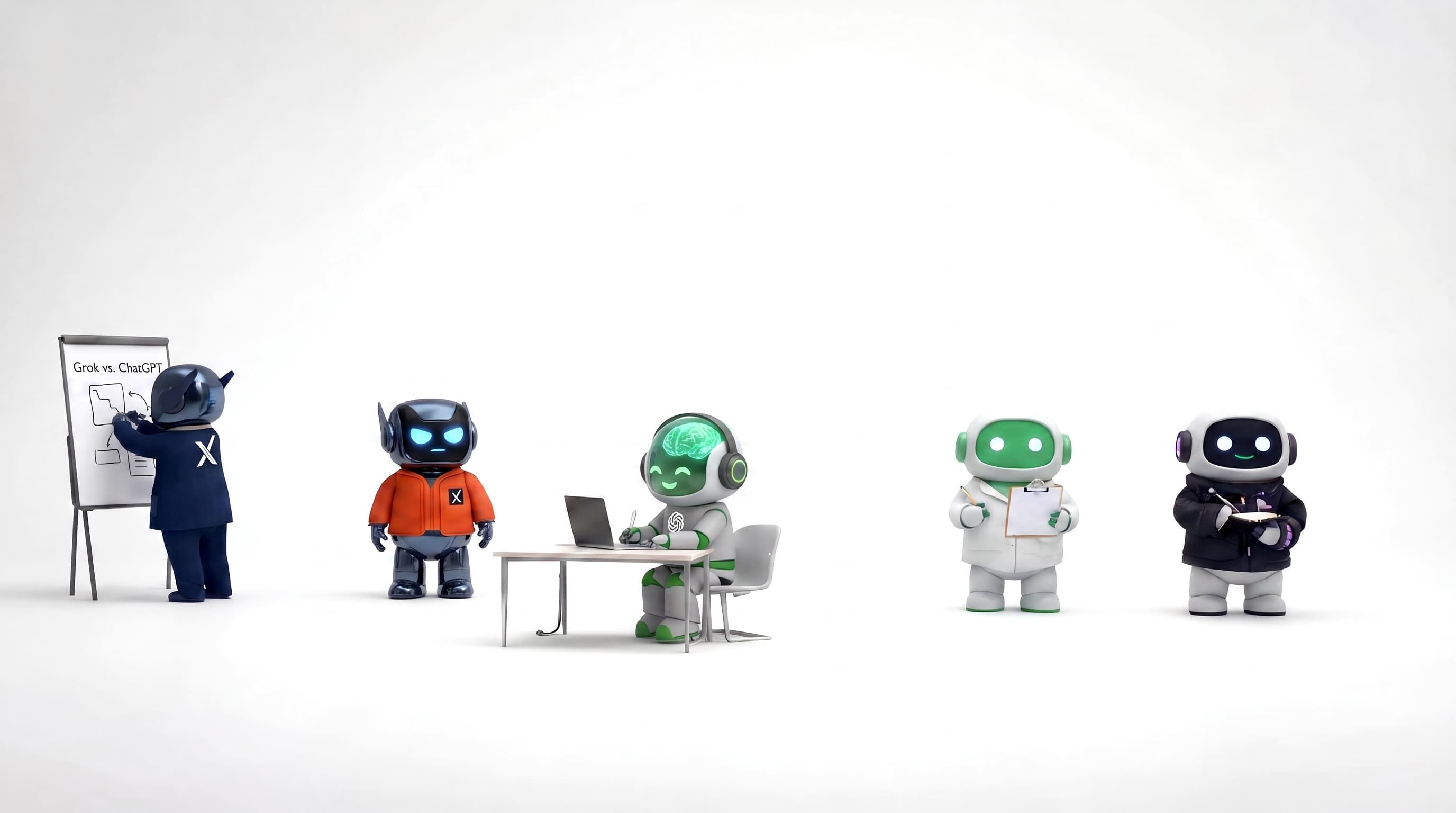

Grok and ChatGPT are two of the most-used AI assistants, from xAI and OpenAI, and they have distinct personalities. Grok is plugged into X with real-time data and a more candid, less filtered tone. ChatGPT is the polished all-rounder with the largest ecosystem around it. This guide compares them across the things that actually matter day to day: real-time information, reasoning, coding, tone, ecosystem, and price.
If you are weighing the other major assistants too, read this alongside ChatGPT vs. Gemini and ChatGPT vs. Claude.
Quick verdict
Choose Grok if you want real-time information from X and the live web, a candid tone, and tight integration if you are active on X. Choose ChatGPT if you want the most polished, consistent all-rounder with top-tier coding and the largest ecosystem. Grok has the edge on freshness and personality; ChatGPT has the edge on breadth, reliability, and tooling.
The fundamental difference
Grok: real-time and candid
Grok, from xAI, is integrated with X and emphasizes live information and a direct, informal style. It is strong on current events and can draw on the live conversation happening on X. The trade-off is a smaller ecosystem and a tone that will not suit every professional setting.
Philosophy: a real-time, candid assistant plugged into the live web and X.
ChatGPT: polished and all-round
ChatGPT is a refined assistant for writing, coding, and reasoning, extended by custom GPTs, voice, image tools, and a huge integration ecosystem. The trade-off is that real-time data is not its default focus; it browses when asked but leans on trained knowledge otherwise.
Philosophy: a polished, general assistant backed by a large ecosystem.
Feature comparison
Real-time information
Grok's live access to X and current events is its signature strength, making it a strong pick for what is happening right now. ChatGPT can browse the web for fresh data, but defaults to its trained knowledge unless prompted, so it is a step behind on real-time by default.
Winner: Grok for up-to-the-minute, social-driven information.
General reasoning and writing
ChatGPT is consistently strong across a very wide range of tasks and is a dependable default. Grok is a capable, improving reasoner and writer, competitive on many tasks, but ChatGPT's consistency across the widest range still gives it the edge.
Winner: ChatGPT.
Coding
ChatGPT is among the best coding assistants, with strong generation, debugging, and explanation, plus mature developer tooling and integrations. Grok can code and is improving quickly, but coding is not yet its headline strength.
Winner: ChatGPT.
Tone and style
Grok is candid and informal by design, which many users enjoy for brainstorming or a less corporate feel. ChatGPT is neutral and highly steerable, easy to keep professional for business use. This one is preference, not a clear win.
Winner: Preference. Grok for personality, ChatGPT for a safe default.
Ecosystem and pricing
ChatGPT has the larger ecosystem, custom GPTs, plugins, and broad integrations, and sits around twenty dollars per month for its paid tier. Grok is centered on X, with a smaller extensibility story, and is often tied to an X subscription. Verify current plans on each vendor's site, since pricing shifts.
Winner: ChatGPT for ecosystem breadth.
Side-by-side
| Factor | Grok | ChatGPT |
|---|---|---|
| Real-time data | Strong (X, live web) | Browses when asked |
| Reasoning / writing | Strong | Excellent, consistent |
| Coding | Improving | Class-leading |
| Tone | Candid, informal | Neutral, adaptable |
| Ecosystem | X-centered | Custom GPTs, huge |
| Best for | Current events, personality | Polished all-round work |
| Type | Chatbot / assistant | Chatbot / assistant |
In practice: the same task, two tools
You want a quick brief on a breaking industry story plus a polished LinkedIn post about it.
With Grok, the brief is current and grounded in the live discussion on X, capturing what people are actually saying right now.
With ChatGPT, the LinkedIn post comes back polished and on-tone, easy to ship, though for the very latest developments you may need to prompt it to browse.
The pattern: Grok wins on what is happening now, ChatGPT wins on polished, dependable output.
Best use cases
Reach for Grok when you are:
-
Tracking breaking news or current events
-
Active on X and want tight integration
-
Brainstorming and enjoy a candid, informal tone
Reach for ChatGPT when you are:
-
Coding or building with custom GPTs and integrations
-
Producing polished, professional writing
-
Doing varied work and want a dependable all-rounder
Limitations to keep in mind
Both can be confidently wrong, so review important output. Grok's candid tone is not ideal for every professional context, and its ecosystem is smaller. ChatGPT is a step behind on real-time by default and needs prompting to browse. Capabilities and pricing move quickly on both sides.
The reality: both are chatbots
Here is what neither Grok nor ChatGPT changes: they are chatbots. You ask, they answer, and then you do the work. They generate text, but they do not send the email, update the CRM, or run the task across your tools. For a lot of real work, the bottleneck is not a better answer, it is that a human still has to act on it.
That is a different category: an AI employee platform. Agently provides AI employees for sales, operations, marketing, support, and research that act across your tools. They share a company brain and work in one workspace, so instead of handing you a draft, they do the task and bring back the result. Grok and ChatGPT answer. Agently's AI employees act.
Bottom line
Choose Grok for real-time information, a candid style, and tight X integration.
Choose ChatGPT for polished, consistent all-round work, top-tier coding, and the largest ecosystem.
Look beyond both if your bottleneck is not the answer but the doing, and you want AI employees that act with a shared brain in one workspace.
Agently provides AI employees that work alongside your team in a shared workspace, handling sales, marketing, operations, support, and research. Try it free.